
Justin H. Joe · May 17, 2026
Mold Symptoms in the Elderly: The Warning Signs NY, NJ and CT Families Are Missing
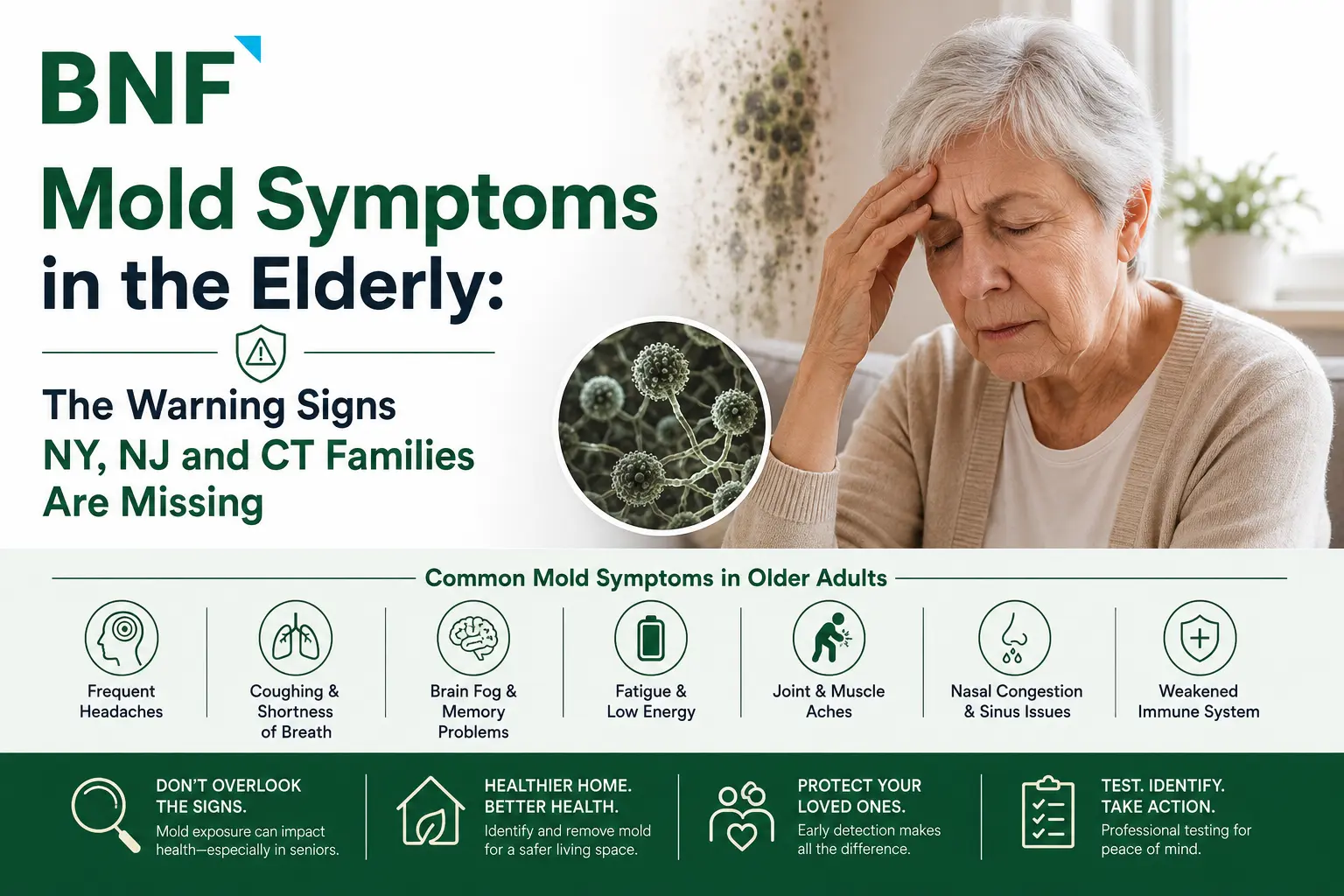
The phone call usually starts the same way. An adult child in Westchester or Bergen County calls because their parent has been declining. The doctor has run tests. Nothing explains it. They are sleeping more, eating less, moving more slowly, forgetting things they would not have forgotten two years ago. Their breathing has gotten worse.
At some point someone suggests checking the house. And almost always, when a CIH-led inspection is conducted, there is mold.
Mold exposure in elderly adults is one of the most underdiagnosed environmental health problems in the tri-state region. The symptoms of mold exposure in older adults look almost identical to the symptoms of aging. Doctors and family members attribute them to the wrong cause for months or years, and the person continues living in the environment making them sick.
This guide is for adult children, caregivers, home health aides, and physicians caring for elderly adults in New York, New Jersey, and Connecticut who suspect the home environment may be a contributing factor in their loved one's decline.
Why Elderly Adults Are More Vulnerable to Mold
Reduced Immune Function
A process called immunosenescence gradually reduces the body's ability to respond to environmental threats with age. What a healthy thirty-year-old immune system might neutralize with a mild response can trigger a prolonged, severe, and systemic reaction in a seventy or eighty-year-old exposed to the same mold contamination.
Compromised Respiratory Capacity
Aging reduces lung elasticity and mucociliary clearance, the system that sweeps inhaled particles out of airways. Mold spores that a younger respiratory system might clear relatively quickly can accumulate in elderly adults, increasing both inflammation and mycotoxin absorption. Elderly adults with existing COPD, emphysema, or smoking history face even greater risk.
Polypharmacy
The average elderly adult takes multiple prescription medications. Corticosteroids, immunosuppressants, proton pump inhibitors, and certain blood pressure medications all reduce the body's ability to respond to mold exposure. An elderly resident on immunosuppressive therapy living in a moldy home is at significantly higher risk than a peer on no medications.
More Time Indoors
The EPA estimates Americans spend 90 percent of their time indoors. For elderly adults with mobility limitations, that figure is often 95 percent or higher. Extended exposure to even moderate contamination levels can produce significant health effects in an elderly resident who almost never leaves home.
Warning Signs: Mold Exposure Symptoms in Elderly Adults
Respiratory Symptoms
Persistent cough that does not respond to treatment. Recurrent bronchitis or pneumonia more frequently than in previous years. Worsening of existing asthma or COPD with no clear trigger. Shortness of breath during previously manageable activities. Symptoms that are worse at home and improve during hospital stays or extended visits elsewhere.
More Time Indoors
Accelerated memory decline or confusion out of proportion to existing diagnoses. Increased brain fog, difficulty concentrating, new or worsening balance problems. Unusual fatigue, excessive sleep, mood changes including irritability or depression with no clear trigger. Mycotoxins cross the blood-brain barrier and trigger neuroinflammation that in elderly adults can produce symptoms that closely mimic dementia progression.
Immune and Allergic Symptoms
Chronic sinus infections that do not resolve with antibiotics. Persistent eye irritation or watering. Skin rashes or hives with no identified allergen. Recurring ear infections. Nosebleeds more frequent than previously experienced.
Sleep and Fatigue
Fatigue disproportionate to activity level. Disrupted sleep or insomnia. Waking exhausted after a full night. Excessive daytime sleepiness. Mold disrupts sleep through melatonin suppression, elevated nighttime cortisol, and histamine activation. In elderly adults whose sleep is already more fragile, this disruption can severely impact cognitive function and cardiovascular health.
The Homes Most at Risk in NY, NJ and CT
Elderly adults in the tri-state region are disproportionately likely to live in older housing stock, often the same home for decades. Pre-war construction in New York City boroughs and northern New Jersey contains original plaster walls, original window frames, and plumbing modified many times over the decades.
Westchester County, Putnam County, and the Hudson Valley have large numbers of older single-family homes where elderly residents may be living alone following the loss of a spouse, with deferred maintenance creating unaddressed moisture issues.
Bergen County, Essex County, and Hudson County in New Jersey have dense older housing stock where basement moisture and proximity to river watersheds create elevated baseline mold risk. Connecticut's Fairfield County and Litchfield County have significant numbers of historic homes where building age creates chronic moisture management challenges.
What to Do If You Suspect Mold Is Affecting an Elderly Family Member
Document the symptom pattern. Are symptoms worse at home than elsewhere? Did they improve during a hospital stay or visit to a family member's home? Did they return when they came back? This location-specific pattern is the strongest clinical indicator.
Share the concern with their physician. Raise the question of environmental mold exposure specifically. Ask whether mycotoxin testing would be appropriate. Many physicians are not trained to identify mold-related illness as a primary diagnosis but will investigate when prompted.
Schedule a professional mold inspection. A consumer-grade DIY test kit is not adequate. You need a CIH-led inspection with air sampling, moisture mapping, and accredited laboratory analysis producing a written, defensible report.
Do not disturb visible mold before the inspection. Disturbing mold releases a pulse of spores that dramatically increases acute exposure. Document visible growth with photographs and keep the elderly resident away from the affected area.
Consider temporary relocation during remediation. If significant contamination is found, elderly adults are among the highest-priority candidates for temporary relocation during the remediation process. Elderly adults with compromised immune function should not be in the building during active remediation.
Why Independent Testing Matters
The stakes are high when an elderly family member's health is involved. BNF Consulting does not perform mold remediation. Our only interest is in giving you an accurate assessment of what is actually in that environment. If contamination is present, we tell you exactly what scope of work is warranted so you can make informed decisions. If the home is clean, we tell you that too.
This independence is what makes our reports trusted by physicians, geriatric care managers, elder law attorneys, and real estate attorneys handling estate matters across New York, New Jersey, and Connecticut.
BNF Consulting Serves Elderly Residents Across the Tri-State Region
New York: Manhattan, Brooklyn, Queens, the Bronx, Staten Island, Westchester County, Nassau County, Suffolk County, Putnam County, Rockland County, Orange County, Dutchess County, Ulster County.
New Jersey: Bergen County, Essex County, Hudson County, Passaic County, Union County, Morris County.
Connecticut: Fairfield County, New Haven County, Litchfield County.
Call (914) 297-8335 for a free phone consultation. Same-day quotes available.
Book online: https://clienthub.getjobber.com/booking/c7837e10-82ff-4b7c-a467-859ed8a7ea08/
Frequently Asked Questions
Q: Can mold make an elderly person sick even if they cannot smell it?
A: Yes. Many serious mold species including Stachybotrys produce little or no odor. Elderly adults with reduced olfactory sensitivity may be even less likely to detect a problem by smell. Air sampling is the only reliable way to measure actual spore concentrations.
Q: Why are elderly adults more affected by mold than younger people?
A: Elderly adults have reduced immune function, diminished respiratory capacity, higher rates of pre-existing conditions, polypharmacy that suppresses immune response, and significantly more time spent indoors. All of these factors combine to make the same level of contamination more dangerous for an elderly person.
Q: Can mold exposure accelerate cognitive decline in elderly adults?
A: Research suggests yes. Mycotoxins cross the blood-brain barrier and trigger neuroinflammation. In elderly adults with existing neurological vulnerability, this can produce or accelerate cognitive symptoms including memory loss and confusion that closely mimic dementia progression.
Q: Can mold cause worsening COPD or asthma in elderly adults?
A: Yes. Mold spores and mycotoxins are potent respiratory irritants. In elderly adults with existing COPD, emphysema, or asthma, mold exposure triggers airway inflammation that directly worsens these conditions. Elderly adults whose respiratory function worsens at home should have their home inspected for mold as part of their clinical workup.
Q: Should an elderly person leave their home during a mold inspection?
A: The inspection itself does not require relocation. However, if significant contamination is found and remediation is recommended, temporary relocation during remediation is strongly advisable for elderly adults, particularly those with respiratory conditions or compromised immune function.
Q: What mold species are most dangerous for elderly adults?
A: Stachybotrys chartarum is most associated with mycotoxin production and serious neurological and immune effects. Aspergillus species are particularly concerning for elderly adults with weakened immune systems, as Aspergillus can cause invasive aspergillosis in immunocompromised individuals. Penicillium and Cladosporium are most commonly detected and cause significant respiratory irritation.
Q: How do I talk to an elderly parent about getting their home tested?
A: Frame it as a routine health check rather than a suggestion that something is wrong with their home. Explain that a professional inspection gives everyone peace of mind and that the results, positive or negative, help the family make informed decisions about the home environment.
Q: Does Medicare or insurance cover mold testing?
A: Standard health insurance and Medicare do not typically cover environmental mold testing. Homeowner's insurance may cover mold-related damage depending on the policy and cause of moisture. BNF Consulting provides detailed written reports that can be submitted to insurance carriers for claims purposes.
Internal Links:
Mold Symptoms in Kids: https://www.askbnf.com/post/mold-symptoms-in-kids-every-nyc-nj-parent-should-know
Can Mold Cause Brain Fog: https://www.askbnf.com/blog/can-mold-cause-brain-fog-and-fatigue
Mold and Sleep Problems: https://www.askbnf.com/post/mold-and-sleep-problems
Mold Testing New Jersey: https://www.askbnf.com/mold-testing-new-jersey
Mold Testing Brooklyn: https://www.askbnf.com/mold-inspection-brooklyn-ny
Mold Inspection Westchester: https://www.askbnf.com/post/mold-inspection-westchester-ny-1
IAQ Testing Companies: https://www.askbnf.com/post/indoor-air-quality-testing-companies
Westchester County: https://www.askbnf.com/westchester-county-ny
Bergen County NJ: https://www.askbnf.com/bergen-county-nj
All NJ Locations: https://www.askbnf.com/nj
Mycotoxin Testing: https://www.askbnf.com/mycotoxin-testing
Mold Inspection Service: https://www.askbnf.com/mold-inspection
Call (914) 297-8335 for a free consultation.
BNF Consulting
240 E Palisade Ave, Englewood, NJ 07631
Hours: Monday to Friday 8AM to 8PM | Saturday 8AM to 5PM
By Dr. Justin Joe, Certified Industrial Hygienist (CIH), Founder of BNF Consulting. Updated May 16, 2026.