
Justin H. Joe · May 16, 2026
What Are Mycotoxins and Why Are They More Dangerous Than Mold Spores?
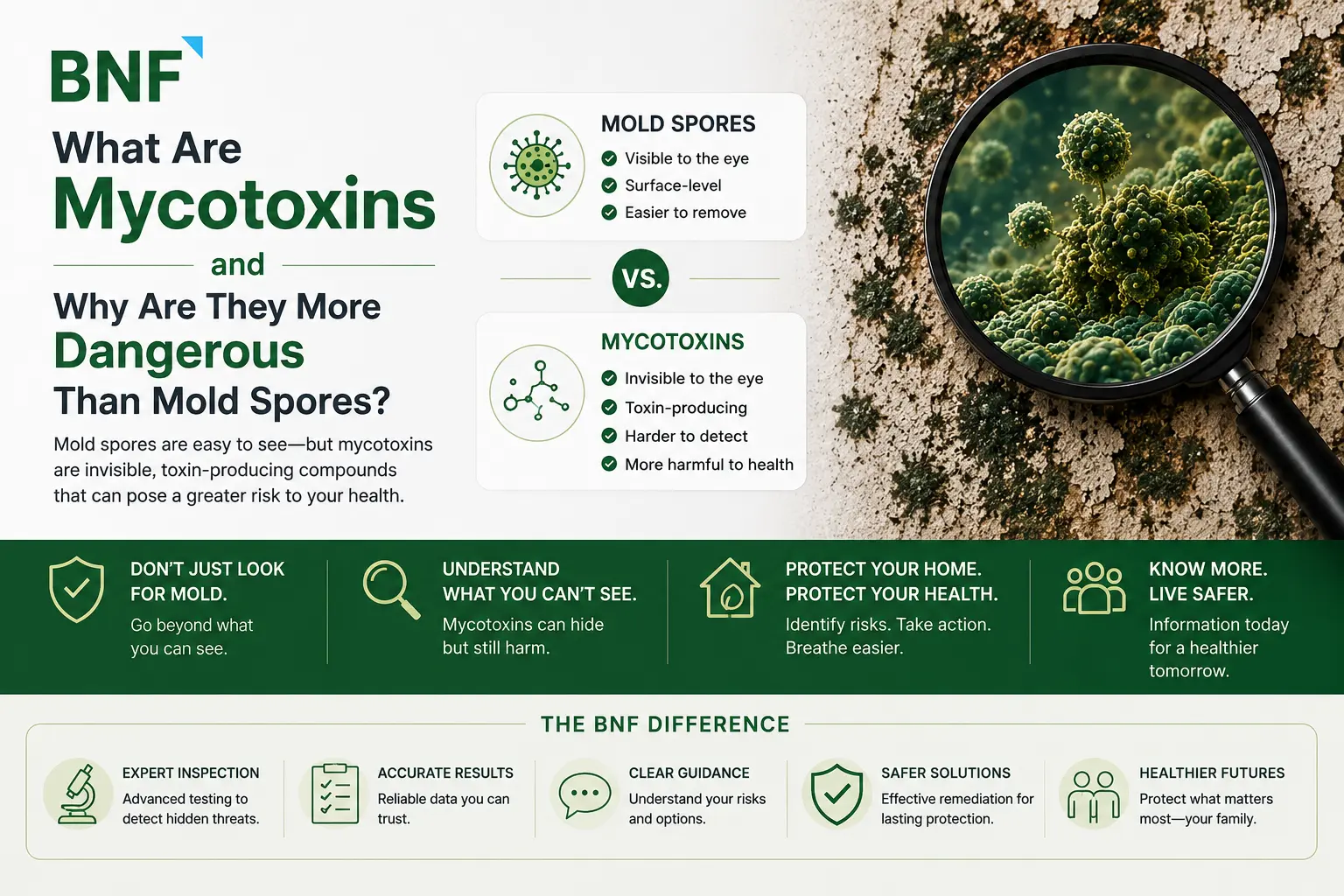
When most people think about mold, they think about spores. The black spots on a bathroom wall. The musty smell in a basement. The air sample that comes back showing elevated Cladosporium or Aspergillus counts.
But spores are only part of the story. And for many of the people who are most seriously affected by mold in their homes, they may not even be the most important part.
Mycotoxins are the toxic chemical compounds that certain mold species produce and release into the air and onto surfaces. They are not spores. They are not alive. They are secondary metabolites, chemical byproducts of mold metabolism, and they can cause serious neurological, immune, and hormonal damage at concentrations that standard mold air sampling will never detect because standard mold testing is not designed to measure them.
This matters enormously for anyone who has had a mold inspection that came back normal but is still experiencing symptoms. It matters for anyone who has been told their mold problem was remediated but continues to feel unwell. And it matters for any physician or clinician trying to understand why a patient's symptoms do not fit a clean diagnosis.
Mold Spores vs Mycotoxins: What Is the Difference?
A mold spore is the reproductive unit of a fungal organism. Spores are released into the air as part of the mold's natural lifecycle, they are inhaled, and they can trigger allergic and inflammatory responses in the respiratory system. Standard mold air sampling, the kind used in most residential mold inspections, measures spore counts and identifies the species present.
Mycotoxins are not spores. They are microscopic chemical compounds produced by the mold colony itself as a defense mechanism and a byproduct of its metabolic processes. They are far smaller than spores, small enough to remain airborne for extended periods and to penetrate deep into lung tissue where spores would not reach. They can also be absorbed through the skin and through ingestion of contaminated food.
The critical distinction is this: you can have a home with low spore counts and still have significant mycotoxin contamination. And you can remediate the visible mold and remove the spore source while mycotoxins remain embedded in porous materials, dust, and building contents throughout the property.
Which Mold Species Produce Mycotoxins?
Not all mold species produce mycotoxins. The most clinically significant mycotoxin-producing species found in residential properties in New York, New Jersey, and Connecticut include the following.
Stachybotrys chartarum
Commonly known as black mold, Stachybotrys produces trichothecene mycotoxins, among the most potent and well-studied of all mycotoxins. Stachybotrys requires prolonged moisture to grow and is commonly found in homes with a history of water damage, flooding, or chronic moisture intrusion. It grows on cellulose-rich materials including drywall paper, ceiling tiles, wood, and cardboard.
Aspergillus and Penicillium
These two genera, often grouped together in air sampling reports as Aspergillus/Penicillium, include many species that produce mycotoxins including aflatoxins, ochratoxin A, and citrinin. Aspergillus and Penicillium are among the most commonly detected molds in residential buildings and are found in a wide range of moisture conditions, not just severe water damage.
Chaetomium
Chaetomium produces chaetoglobosins, mycotoxins with significant neurological and immune effects. It is commonly found in water-damaged drywall and is often present alongside Stachybotrys in properties with chronic moisture problems. Chaetomium is less commonly identified in standard mold reports because it is often grouped under less specific categories.
Mycotoxin Health Effects: Why the Clinical Picture Is So Complex
The health effects of mycotoxin exposure are one of the most contested and evolving areas in environmental medicine. The complexity arises from several factors that make mycotoxin illness difficult to diagnose through standard clinical pathways.
Multi-System Effects
Mycotoxins affect multiple organ systems simultaneously. Neurological effects include brain fog, memory impairment, difficulty concentrating, mood changes, anxiety, depression, and in severe cases, tremors and coordination problems. Immune effects include chronic inflammation, increased susceptibility to infection, and in some individuals, autoimmune-like responses. Respiratory effects include airway inflammation, chronic cough, and worsening of existing asthma. Hormonal effects include disruption of the hypothalamic-pituitary axis, affecting cortisol regulation, thyroid function, and reproductive hormones.
Individual Variation in Susceptibility
Genetic variation in the HLA gene system affects how effectively the body clears mycotoxins. Approximately 25 percent of the population carries HLA gene variants that significantly reduce mycotoxin excretion, meaning that a quarter of people exposed to the same environment will accumulate far higher mycotoxin burdens than the rest. This is one reason why two people can live in the same moldy home and one is severely affected while the other has minimal symptoms.
Persistence After Removal of the Source
Unlike spores, mycotoxins do not die or become inert when the mold colony is removed. They persist in dust, porous materials, textiles, furniture, and HVAC systems long after remediation. People who have had mold remediation but continue to experience symptoms are often being re-exposed to mycotoxins that remained in the building's contents and materials.
Why Standard Mold Testing Misses Mycotoxins
Standard mold air sampling using spore trap cassettes counts and identifies fungal spores. It does not detect mycotoxins. These are two fundamentally different analyses requiring different collection methods and different laboratory processes.
This creates a significant diagnostic gap. A home can test negative on a standard mold air sample while containing significant mycotoxin contamination from a previous mold problem that has been partially remediated, from spores that are no longer actively releasing but have left mycotoxin residue in building materials, or from mold growing in inaccessible locations that is producing mycotoxins that travel through the air supply before the spores themselves become detectable.
Mycotoxin testing requires specific collection of dust samples or air samples using protocols designed to capture chemical compounds rather than spores, followed by laboratory analysis using ELISA or mass spectrometry methods to identify and quantify the specific mycotoxin compounds present.
BNF Consulting Provides Mycotoxin Testing Across NY, NJ and CT
BNF Consulting provides mycotoxin testing as a standalone service and as part of a comprehensive mold and indoor air quality assessment. Every mycotoxin inspection is led or reviewed by Dr. Justin Joe, CIH, PhD, with over 11 years of experience in environmental health across the tri-state region.
We do not perform mold remediation. Our mycotoxin testing results are fully independent and structured to be usable in medical consultation, insurance claims, and legal proceedings.
New York: Manhattan, Brooklyn, Queens, the Bronx, Staten Island, Westchester County, Nassau County, Suffolk County, Putnam County, Rockland County, Orange County, Dutchess County, Ulster County.
New Jersey: Bergen County, Essex County, Hudson County, Passaic County, Union County, Morris County.
Connecticut: Fairfield County, New Haven County, Litchfield County.
Call (914) 297-8335 for a free phone consultation. Same-day quotes available.
Book online: https://clienthub.getjobber.com/booking/c7837e10-82ff-4b7c-a467-859ed8a7ea08/
Frequently Asked Questions
Q: What is the difference between mold and mycotoxins?
A: Mold is a living organism that produces spores as part of its reproductive cycle. Mycotoxins are toxic chemical compounds that certain mold species produce as byproducts of their metabolism. Mold spores can trigger allergic and inflammatory responses. Mycotoxins cause more serious neurological, immune, and hormonal effects and persist in the environment long after the mold itself is removed.
Q: Can you have mycotoxin exposure with no visible mold?
A: Yes. Mycotoxins can remain embedded in porous materials, dust, and building contents after a mold colony has been remediated or has died. A property with no currently active mold growth can still have significant mycotoxin contamination. This is one reason people continue to experience symptoms after mold remediation.
Q: What are the symptoms of mycotoxin exposure?
A: Mycotoxin symptoms span multiple systems and include brain fog, memory impairment, difficulty concentrating, mood changes, chronic fatigue, headaches, respiratory irritation, chronic sinus infections, joint pain, increased chemical sensitivities, and hormonal disruption. Neurological symptoms are among the most commonly reported and most difficult to connect to an environmental cause through standard clinical testing.
Q: Does standard mold testing detect mycotoxins?
A: No. Standard mold air sampling using spore trap cassettes counts and identifies fungal spores. It does not detect mycotoxins, which require different collection methods and laboratory analysis. A home can test clean on a standard mold air sample and still have significant mycotoxin contamination.
Q: Who should get mycotoxin testing?
A: Mycotoxin testing is particularly valuable for people who have had a standard mold inspection that came back normal but are still experiencing symptoms consistent with mold-related illness. It is also appropriate for people who have had mold remediation but continue to feel unwell, for properties with a significant history of water damage, and for clinicians working up patients with complex, multi-system symptoms that do not fit a standard diagnosis.
Q: How is mycotoxin testing done?
A: Mycotoxin testing involves collection of dust samples from surfaces throughout the property or specialized air sampling, followed by laboratory analysis using ELISA immunoassay or mass spectrometry methods to identify and quantify specific mycotoxin compounds. BNF Consulting coordinates collection and accredited laboratory analysis as part of every mycotoxin inspection engagement.
Q: Can mycotoxins be removed from a home?
A: Mycotoxin remediation is more complex than standard mold remediation because mycotoxins persist in porous materials and contents that spore-focused remediation does not address. Professional mycotoxin remediation includes treatment of affected materials with appropriate antimicrobial agents, HEPA filtration of contents, and in some cases replacement of heavily contaminated porous materials. A post-remediation mycotoxin test confirms whether levels have been reduced to acceptable ranges.
Q: Why do some people react severely to mold while others in the same home do not?
A: Approximately 25 percent of the population carries HLA gene variants that significantly reduce the body's ability to clear mycotoxins. People with these variants accumulate higher mycotoxin burdens from the same exposure and experience more severe symptoms. Pre-existing immune conditions, age, and overall health status also affect individual susceptibility.
Internal Links:
Mycotoxin Testing service: https://www.askbnf.com/mycotoxin-testing
Mold Inspection service: https://www.askbnf.com/mold-inspection
Mold Testing service: https://www.askbnf.com/mold-testing
Indoor Air Quality Testing: https://www.askbnf.com/indoor-air-quality-testing
Can Mold Cause Brain Fog: https://www.askbnf.com/blog/can-mold-cause-brain-fog-and-fatigue
Mold and Sleep Problems: https://www.askbnf.com/post/mold-and-sleep-problems
Mold Symptoms Elderly: https://www.askbnf.com/post/mold-symptoms-in-elderly-ny-nj-ct
IAQ Testing Companies: https://www.askbnf.com/post/indoor-air-quality-testing-companies
Westchester County: https://www.askbnf.com/westchester-county-ny
Bergen County NJ: https://www.askbnf.com/bergen-county-nj
All NJ Locations: https://www.askbnf.com/nj
Mold Testing Brooklyn: https://www.askbnf.com/mold-inspection-brooklyn-ny
Mold Testing New Jersey: https://www.askbnf.com/mold-testing-new-jersey
Call (914) 297-8335 for a free consultation.
BNF Consulting
240 E Palisade Ave, Englewood, NJ 07631
Hours: Monday to Friday 8AM to 8PM | Saturday 8AM to 5PM
By Dr. Justin Joe, Certified Industrial Hygienist (CIH), Founder of BNF Consulting. Updated May 16, 2026.