
Justin H. Joe · March 20, 2026
Why Mold Is So Common in NYC Apartment Buildings
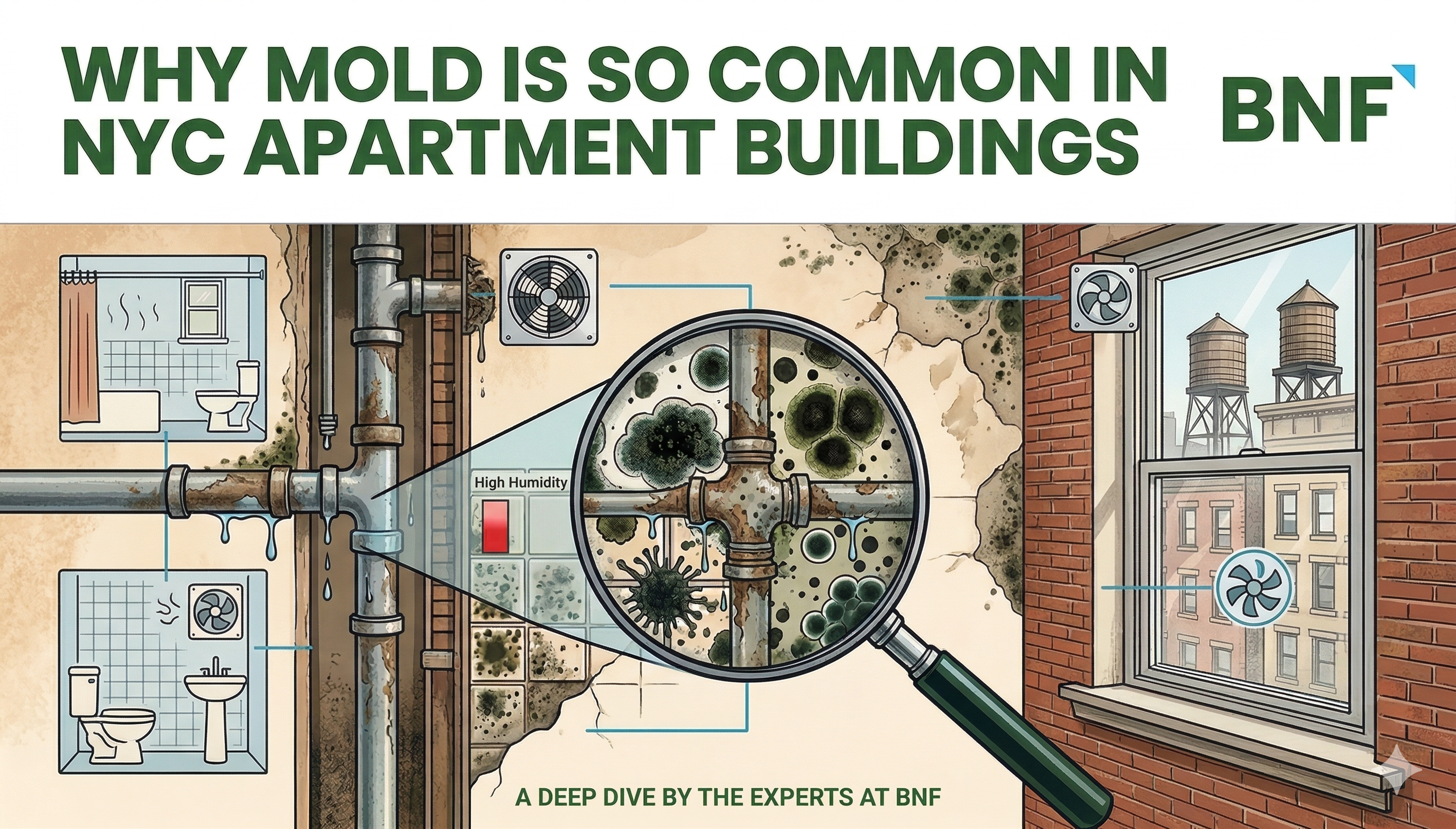
Living in the five boroughs means dealing with a lot — cramped spaces, loud neighbors, and surprisingly brutal summers. But one problem that doesn't get talked about enough is mold. It shows up behind bathroom tiles, under kitchen sinks, and inside walls where you'd never think to look. And once it takes hold, it doesn't leave quietly.
There were over 41,000 HPD mold complaints filed in New York City in fiscal year 2024 alone. That number isn't a fluke — it reflects something deeply structural about the way this city was built and the climate it sits in. If you're dealing with apartment mold NYC is notorious for, you're not alone, and you're not powerless.
This guide breaks down exactly why mold is so persistent in city buildings, what the law says about it, and what you can actually do.
The Age of NYC's Building Stock
The single biggest driver of mold problems NYC apartment buildings face is age. According to the 2023 NYC Housing and Vacancy Survey, 54 percent of the city's housing units were built before 1947. That's over two million homes with decades-old plumbing, degraded waterproofing, and layers of renovation work that often trapped moisture rather than eliminating it.
Pre-war buildings mold issues are almost inevitable. Original cast-iron pipes corrode from the inside out. Exterior brick loses its waterproofing seal over time. Bathroom grout cracks, caulk peels, and behind every one of those small failures is a pathway for water to enter a wall cavity and never leave. Once moisture is trapped in aging infrastructure, it rarely dries on its own — it just sits there and feeds whatever spores happen to land on it.
Humidity and Climate: NYC's Year-Round Mold Factory
New York's climate is one of the most underappreciated NYC apartment mold causes. The city sits on a coastal plain that traps humidity in summer and creates intense condensation cycles in winter. The EPA recommends keeping indoor humidity below 60 percent to prevent mold growth — but during a typical August in Brooklyn or the Bronx, outdoor humidity regularly blows past that threshold before you even open a window.
When that warm, muggy air hits an aggressively air-conditioned apartment, condensation forms on windows, cold pipes, and exterior-facing walls. Come January, the cycle flips — warm indoor air meets freezing windowpanes and produces the same result. This back-and-forth is relentless, and it's why late summer through early fall tends to be peak season for mold complaints across all five boroughs.
Poor Ventilation Traps Moisture Indoors
Space is scarce in New York, and many apartments were carved out of larger floor plans with little thought given to airflow. Countless units — especially in older Bronx and Brooklyn walk-ups — have bathrooms and kitchens with no exterior windows at all. Steam from a hot shower or a boiling pot has nowhere to go except into the walls.
Buildings are supposed to compensate for this with mechanical exhaust fans and HVAC systems. In practice, those systems are frequently clogged with decades of dust, broken entirely, or venting into another enclosed space rather than outside. When moisture can't escape, it settles on ceilings and walls, and early-stage mold colonies get established faster than most residents realize.
Basement Apartments and Ground-Floor Units
If you live below grade or on the ground floor, you're fighting a different battle entirely. These units sit in direct contact with surrounding soil, and concrete and brick — no matter how solid they look — are naturally porous materials. After heavy rain or snowmelt, groundwater actively wicks upward through the foundation.
Without proper vapor barriers and dedicated dehumidification, that moisture becomes trapped in your floors and lower walls. It's one of the most common NYC apartment mold causes for ground-floor tenants, and because the water source is underground rather than overhead, residents often have no idea where the dampness is coming from until visible staining appears.
Plumbing Leaks: The Hidden Culprit
Not every mold problem comes from the weather. Sometimes the source is a pinhole leak in a pipe inside your wall that's been dripping for six months without anyone knowing. NYC's aging water infrastructure is riddled with these — slow, quiet leaks that produce no dramatic flooding but create the perfect sustained moisture environment for a serious mold colony to establish itself.
This is where mold problems NYC apartment buildings see most often become genuinely dangerous. A dripping shower valve, a weeping radiator joint, a slow drain connection — none of these announce themselves. By the time you notice a soft spot in your baseboard or a suspicious dark stain near the ceiling, the mold has already spread well beyond what you can see. Hidden mold behind walls is far more common than visible surface growth, and it requires professional tools to locate.
Your Legal Rights as a NYC Tenant
Here's something a lot of renters don't know: tenant rights mold NYC laws are actually quite strong. Under Local Law 55 of 2018 — the Asthma-Free Housing Act — landlords of buildings with three or more units are legally required to investigate and fix indoor allergen hazards. That includes mold, and it includes fixing the underlying moisture source — not just painting over the dark spots.
When an HPD violation is issued, the landlord typically has 21 to 30 days to correct it depending on the severity. And critically, under New York State law, any moldy area exceeding 10 square feet requires a licensed independent mold assessor — the remediation contractor and the assessor must be different companies. That rule exists specifically to prevent landlords from hiring one company to rush through both jobs.
If your landlord is stalling, document everything in writing, then file an HPD complaint by calling 311. A professional mold inspection report gives you the legally binding evidence that turns a landlord's dismissal into a court-enforceable violation.
Quick Steps to Reduce Your Risk
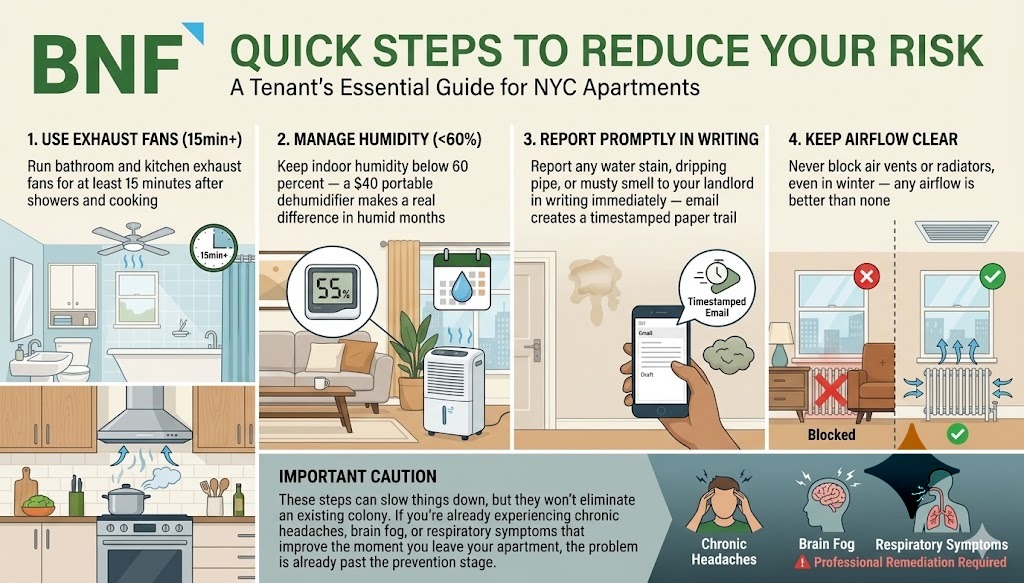
While the structural causes of apartment mold NYC deals with are largely outside tenants' control, a few consistent habits genuinely help:
Run bathroom and kitchen exhaust fans for at least 15 minutes after showers and cooking
Keep indoor humidity below 60 percent — a $40 portable dehumidifier makes a real difference in humid months
Report any water stain, dripping pipe, or musty smell to your landlord in writing immediately — email creates a timestamped paper trail
Never block air vents or radiators, even in winter — any airflow is better than none
These steps can slow things down, but they won't eliminate an existing colony. If you're already experiencing chronic headaches, brain fog, or respiratory symptoms that improve the moment you leave your apartment, the problem is already past the prevention stage.
Why Professional Mold Testing and Inspection Matters
Visible mold on a baseboard or behind a toilet is almost never the full picture. Mold spreads aggressively inside wall cavities, above drop ceilings, under flooring, and inside HVAC ductwork — places you can't see and that a visual check will never catch. For a deeper look at how this affects your health, read our guide on Symptoms of Mold Exposure Every NYC & NJ Homeowner Should Know.
A professional mold inspection NYC tenants can rely on goes far beyond what you can find with a flashlight. BNF Consulting uses thermal imaging cameras and moisture meters to locate hidden water sources without opening your walls. Professional mold testing NYC labs then analyze air and surface samples to identify the exact species present and the concentration of airborne spores — the kind of hard, documented evidence that HPD inspectors, insurance adjusters, and housing court judges actually require.
Take Control of Your Indoor Air Quality
The NYC apartment mold causes we've covered — aging buildings, coastal humidity, poor ventilation, hidden leaks — are structural realities of this city. But that doesn't mean you have to live with the consequences.
BNF Consulting provides certified mold inspection and mold testing across all five NYC boroughs and New Jersey. Led by Dr. Justin Joe, Certified Industrial Hygienist (CIH), our reports are accepted for HPD complaints, insurance claims, and landlord disputes. When you need lab-verified proof to force action, BNF Consulting delivers it.
Call (914) 297-8335 or visit askbnf.com to book your inspection. Free phone consultations are available — take the first step toward breathing easier today.
Frequently Asked Questions
How do I know if I have hidden mold in my apartment?
Musty odors, peeling wallpaper, warped baseboards, and allergy symptoms that improve when you leave home are all strong indicators. If you recognize any of these signs, a professional mold inspection NYC certified assessors provide is the right next step — surface checks alone won't find what's growing inside your walls.
Can I clean it up myself?
Small patches on a bathroom tile or shower grout — under 10 square feet — can usually be handled with proper cleaning products and ventilation. Anything larger, or any growth on drywall, insulation, or wood, requires a licensed remediation contractor under New York State law. DIY scrubbing on larger areas typically scatters spores and makes the problem significantly worse.
What if my landlord won't act?
Send all complaints in writing and keep copies. File an HPD complaint by calling 311. If management continues to stall, hire an independent mold inspection NYC specialist to produce a lab-verified report — that documentation is what moves cases forward in housing court.
What's the difference between mold testing and mold inspection?
An inspection uses physical tools — thermal cameras, moisture meters — to locate hidden moisture and growth. Testing involves collecting air and surface samples that a certified lab analyzes for species and spore concentration. BNF Consulting, led by Dr. Justin Joe CIH, provides both as part of a comprehensive assessment.