
Justin H. Joe · April 15, 2026
Mold in Air Conditioners and Air Ducts — What NYC Apartment Tenants Need to Know
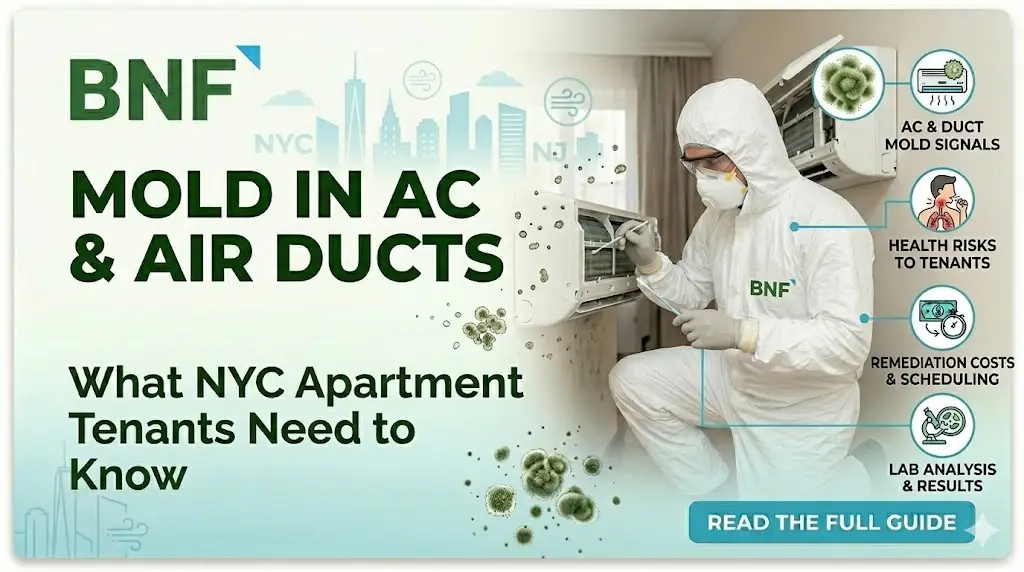
Can mold grow in air conditioners and air ducts? Mold can grow inside air conditioners and air ducts wherever moisture and organic material are present. Components like evaporator coils and drip pans create ideal conditions for mold growth, especially in humid environments like NYC apartments — where aging building infrastructure, deferred maintenance, and coastal humidity combine to make HVAC mold one of the most common hidden environmental problems inspectors find. If you have noticed a musty smell when your air conditioner turns on, visible discoloration around your vents, or unexplained respiratory symptoms that get worse at home — there is a reasonable chance mold is somewhere in your HVAC system. This guide covers how mold gets into air conditioning units and ductwork, why NYC apartments are disproportionately affected, what the health risks are, and when a professional inspection is the right next step — not a cleaning product.
HVAC Mold vs. Surface Mold — Why the Difference Matters
Most people are familiar with mold on a bathroom wall or under a kitchen sink. HVAC mold is a fundamentally different problem — and a more serious one.
Feature | HVAC Mold | Surface Mold |
Visibility | Hidden — inside ducts, coils, drain pans | Visible on walls, ceilings, tile |
Spread | Distributed through the air system to every room | Localized to the affected surface |
Risk level | High — entire apartment or building exposed | Moderate — exposure limited to proximity |
Detection | Requires professional inspection | Often identified visually |
DIY cleaning | Makes it worse — spreads spores | Possible for minor surface growth |
Primary indicator | Musty odor when HVAC runs, location-dependent symptoms | Visible growth, water staining |
The core distinction: surface mold stays where it is. HVAC mold travels. Every time your air conditioning or heating runs, a contaminated system distributes spores to every room it serves — which is why identifying and testing it professionally is the only reliable approach.
Why NYC Apartments Have a Mold Problem in HVAC Systems
New York City has among the highest rates of HVAC-related mold in the country, and the reasons are structural — not just a matter of poor maintenance.
Building age. The majority of NYC's residential housing stock was built before modern ventilation standards existed. Pre-war buildings in Brooklyn, Queens, Manhattan, and the Bronx often have ductwork that was installed decades ago and has never been fully cleaned or assessed. Systems designed for a different era of occupancy now run year-round, accumulating moisture with every cooling cycle.
Humidity. New York City's coastal climate produces consistently high humidity from late spring through early fall. Every time warm, humid outdoor air contacts the cold surfaces inside a central air system or window unit, condensation forms. Without adequate drainage and airflow, that moisture stays — and mold follows.
Density and shared systems. In multi-unit buildings, HVAC systems often serve multiple apartments through shared ductwork. Mold that originates in one part of the building can be distributed to units that show no obvious source of moisture damage on their own.
Deferred maintenance. In rental properties, HVAC maintenance is frequently delayed or performed only at the point of failure. Filters go unchanged, drain lines clog, and coils accumulate debris — each of which accelerates mold growth. Tenants often have limited visibility into what is happening inside their building's mechanical systems.
For a broader look at how NYC's housing stock creates persistent mold conditions, see our guide on why mold is so common in NYC apartment buildings.
How Mold Gets Into Your Air Conditioner and Ductwork
Understanding the mechanism matters because it changes what you look for — and what you should not do on your own.
The evaporator coil. In central air systems and split units, the evaporator coil is the primary site of condensation. As warm air passes over the coil, moisture drops out of the air and is supposed to drain away through a condensate line. When that line clogs — which happens frequently in older systems — water pools around the coil and creates a persistently damp environment where mold establishes quickly.
The drip pan. Below the evaporator coil sits a drip pan designed to catch condensate. In many NYC apartment buildings, these pans are not regularly inspected or cleaned. Standing water in a drip pan is one of the most reliable conditions for mold growth inside an air handling unit.
Window and through-wall AC units. Window units used in NYC apartments are particularly susceptible. They cycle between warm exterior air and cool conditioned air across a small interior space, generating condensation throughout the unit. Mold commonly grows on the interior fins, coils, and foam insulation — components that tenants cannot see or access without disassembling the unit.
Air ducts and vents. Ductwork accumulates dust over years of operation. When humid air moves through ducts that run near exterior walls, below-grade spaces, or uninsulated areas — common in older NYC construction — condensation forms on duct surfaces and mold can establish on the dust layer. Vents and grilles showing visible discoloration are often a surface indicator of a deeper problem inside the duct run.
For a detailed breakdown of how mold establishes inside HVAC systems at the mechanical level, see our earlier guide on how mold grows in HVAC systems.
Signs You Have Mold in Your AC Unit or Apartment Vents
Most HVAC mold is not visible from inside the apartment. But there are reliable indicators that warrant a professional assessment.
Smell-based indicators:
A musty or earthy odor that appears specifically when the air conditioner or heat turns on — and fades when the system is off
A smell that is stronger near vents or registers than in the center of the room
Odor that worsens in summer or during high-humidity periods
Visual indicators:
Visible dark spotting or discoloration on or around vent covers and registers
Black, green, or gray growth visible on the surface of a window AC unit
Discoloration on walls or ceilings near vent openings
Water staining around vents or on the ceiling near an air handler
Health and symptom indicators:
Respiratory symptoms — coughing, wheezing, chest tightness — that are consistently worse at home and improve when you leave
Nasal congestion, eye irritation, or skin rashes that correlate with HVAC use
Symptoms that worsen when the air conditioning or heating is running
Household members with asthma experiencing more frequent attacks at home
The location-dependent pattern is the most important signal. If symptoms appear or worsen at home and improve elsewhere — particularly when the HVAC system is operating — the air system should be the first thing investigated.
Health Risks of Mold in HVAC Systems
HVAC mold carries a specific risk that distinguishes it from mold growing in a bathroom or on a wall: the system actively distributes spores throughout the entire apartment — or building — every time it runs. A person living with bathroom mold can limit their exposure by ventilating. A person living with HVAC mold has no equivalent option while the system is operating.
Respiratory effects are the most commonly reported. Mold spores inhaled from a contaminated air system cause airway inflammation that presents as coughing, wheezing, nasal congestion, and throat irritation. In individuals with existing asthma, the effect can be significant — increasing attack frequency and reducing the effectiveness of standard medication.
Allergic responses occur in individuals sensitized to mold species. Symptoms include itchy and watery eyes, skin rashes, sneezing, and runny nose that follows the pattern of HVAC operation — present when the system runs, improving when it does not.
Headaches and fatigue are frequently reported by individuals with prolonged exposure to elevated indoor mold concentrations. These symptoms are often attributed to other causes before the home environment is investigated.
Children and immunocompromised individuals face elevated risk. Children breathe proportionally more air relative to body weight and spend more time in the home than most adults, resulting in higher daily spore exposure from a contaminated system. For families with children showing unexplained respiratory symptoms, HVAC mold is one of the most important environmental factors to rule out. See our detailed guide on mold and asthma in children — what every NYC and NJ parent should know.
Mold in Window AC Units vs. Central Air vs. Ductwork — What's Different in NYC Apartments
NYC apartments vary significantly in their HVAC setup, and the mold risk profile differs by system type.
Window and through-wall AC units are the most common setup in older NYC apartments — particularly in pre-war buildings in Brooklyn, Queens, and Manhattan. These units are tenant-installed or landlord-provided and are rarely professionally maintained. Because the interior of a window unit is difficult to inspect without disassembly, mold can grow for months or years before any visible sign appears. Tenants who notice a musty smell specifically when the unit turns on should treat this as a mold indicator until demonstrated otherwise.
Central forced-air systems in larger buildings and newer construction distribute conditioned air through a network of ducts. Mold found in the air handling unit — on the coil, in the drain pan, or in the blower — is circulated to every connected room every time the system operates. In multi-unit buildings with shared systems, this represents a building-wide exposure risk, not just an individual apartment problem.
Fan coil units are common in NYC high-rise buildings constructed from the 1960s onward. Each unit contains its own coil and fan but draws from a building-wide chilled water or hot water system. The drain pan in a fan coil unit is a frequent mold site in buildings where maintenance is irregular. Residents of high-rises across Manhattan, Brooklyn, and Staten Island with fan coil systems and unexplained respiratory symptoms should specifically have this unit assessed.
Mini-split systems in newer construction or renovated units are generally lower risk but not immune — particularly if installed without proper drainage or in rooms with elevated humidity.
Is HVAC Mold the Landlord's Responsibility in NYC?
This is one of the most commonly asked questions from NYC tenants who suspect mold in their air system — and the answer has legal weight.
New York City's Local Law 55 (2018) and New York State's Mold Remediation Law require building owners to maintain residential properties free of hazardous mold conditions. Under NYC Housing Maintenance Code, landlords are responsible for maintaining HVAC systems in safe working order. If mold is present in a building-owned or landlord-provided HVAC system, remediation is the landlord's legal obligation — not the tenant's.
The practical challenge is documentation. To compel a landlord to remediate HVAC mold, tenants typically need evidence that the mold exists. A professional inspection report from a certified industrial hygienist provides exactly this — an independent, documented finding that carries weight with building management, the NYC Department of Housing Preservation and Development (HPD), and if necessary, housing court.
BNF Consulting provides testing only — never remediation. This means our inspection reports are fully independent. We have no financial interest in the remediation outcome, which makes our findings more credible when presented to a landlord, a property manager, or a regulatory body.
If you are preparing to file an HPD complaint or document conditions for a housing dispute, a professional mold inspection is the appropriate first step — not a self-test kit, which cannot be used as legal documentation.
What Not to Do If You Suspect HVAC Mold
This section matters because common instincts often make the situation worse.
Do not spray the vents or unit with bleach or mold-killing products. Disturbing mold without containment releases spores into the air at concentrations far higher than the background level. In a small apartment, this creates an acute exposure event that can significantly worsen respiratory symptoms in anyone present.
Do not remove vent covers and attempt to inspect the ductwork yourself. Without proper protective equipment and air containment, disturbing a contaminated duct system spreads spores throughout the apartment.
Do not run the HVAC system at high speed to "air out" the unit. Increased airflow through a contaminated system increases spore distribution.
Do not rely on odor elimination products. Air fresheners, ozone generators, and deodorizers mask musty odors without addressing the mold source. Ozone generators in particular are not recommended for occupied spaces and do not constitute mold remediation.
Do not use a consumer mold test kit as your primary evidence. Tape-lift and air sample kits sold at hardware stores produce results that cannot be properly interpreted without laboratory context and are not accepted as professional documentation by landlords, HPD, or housing court.
The right sequence is: identify the concern, stop disturbing the area, and arrange a professional inspection.
Where BNF Consulting Provides HVAC Mold Inspections
BNF Consulting provides certified mold inspection and indoor air quality testing across the entire tri-state region.
New York City: Brooklyn, Queens, Manhattan, the Bronx, and Staten Island.
Long Island: Nassau County and Suffolk County.
Westchester and the Hudson Valley: Westchester County, Putnam County, Rockland County, Orange County, Dutchess County, Ulster County, Sullivan County, Greene County, and Columbia County.
New Jersey: Bergen County, Essex County, Passaic County, Union County, Hudson County, Morris County, and throughout New Jersey.
Connecticut: Fairfield County, New Haven County, Litchfield County, and throughout Connecticut.
When to Arrange a Professional Mold Inspection for Your HVAC System
Schedule a professional inspection when any of the following apply:
A musty odor is present when the air conditioner or heating turns on
Visible discoloration appears on or around vent covers, registers, or AC unit surfaces
Respiratory symptoms — coughing, congestion, wheezing — are consistently worse at home and improve when you leave
A household member with asthma has experienced increasing attack frequency without a newly identified trigger
You have been in a water damage event — even a minor leak — and the HVAC system was affected or nearby
You are moving into a new NYC apartment and want to assess the air system before occupying
You are preparing to document conditions for an HPD complaint or landlord dispute
Every BNF Consulting inspection is led by Dr. Justin Joe, CIH — the highest credential in environmental health. Because BNF Consulting does testing only, never remediation, our findings are fully independent and carry weight in any landlord, legal, or regulatory context.
Call (914) 297-8335 for a free consultation, or visit askbnf.com.
Frequently Asked Questions
Q: Is it common to get mold in HVAC systems? Yes, particularly in New York City. Mold in HVAC systems is one of the most frequently identified findings in NYC residential inspections. The combination of aging equipment, high seasonal humidity, and deferred maintenance in rental properties creates near-ideal conditions for mold growth on evaporator coils, in drain pans, and inside ductwork. Pre-war apartments in Brooklyn, Queens, and Manhattan have some of the highest rates of HVAC-related mold findings in the region.
Q: Does New York have a mold problem? New York — particularly New York City — has elevated mold risk relative to many other regions. The factors are specific: dense older housing stock, coastal humidity, limited ventilation in high-rise apartments, aging building infrastructure, and high rates of deferred maintenance in the rental market. NYC's Local Law 55 was enacted specifically because mold in residential buildings was identified as a significant public health issue requiring legislative action.
Q: What 100% kills mold in HVAC systems? No consumer product reliably eliminates mold from HVAC systems, and attempting to apply bleach, biocide sprays, or other products to a contaminated system without professional containment typically worsens the problem by distributing spores. Effective HVAC mold remediation requires professional cleaning of affected components — coils, drain pans, blower assemblies, and duct surfaces — by trained remediation contractors, typically following guidance from a professional inspection report. The first step is always to confirm the presence, location, and extent of mold through independent testing before any remediation work begins.
Q: How much does a mold inspection cost in NYC? Mold inspection costs in NYC vary based on the scope of the assessment — apartment size, number of air samples, and the specific areas being evaluated. BNF Consulting provides free consultations to assess what type of inspection is appropriate for your situation. Call (914) 297-8335 to discuss your specific concerns before committing to any service.
Q: What is the difference between mold in HVAC systems and mold on walls or surfaces? HVAC mold is hidden inside mechanical components and is actively spread by the air system to every room it serves. Surface mold is visible and localized. HVAC mold typically requires professional detection and cannot be safely addressed with DIY cleaning — disturbing it releases spores throughout the apartment. Surface mold on walls or tile may be addressable at a small scale but should still be professionally assessed if the source of moisture is not confirmed.
BNF Consulting provides certified mold inspection and indoor air quality testing for tenants, homeowners, and property managers throughout New York City, Westchester County, New Jersey, and Connecticut. Dr. Justin Joe, CIH, leads all inspections. BNF Consulting does testing only — never remediation. Call (914) 297-8335 or visit askbnf.com.