
Justin H. Joe · March 27, 2026
Mold vs Mildew — What's the Difference and Why It Matters
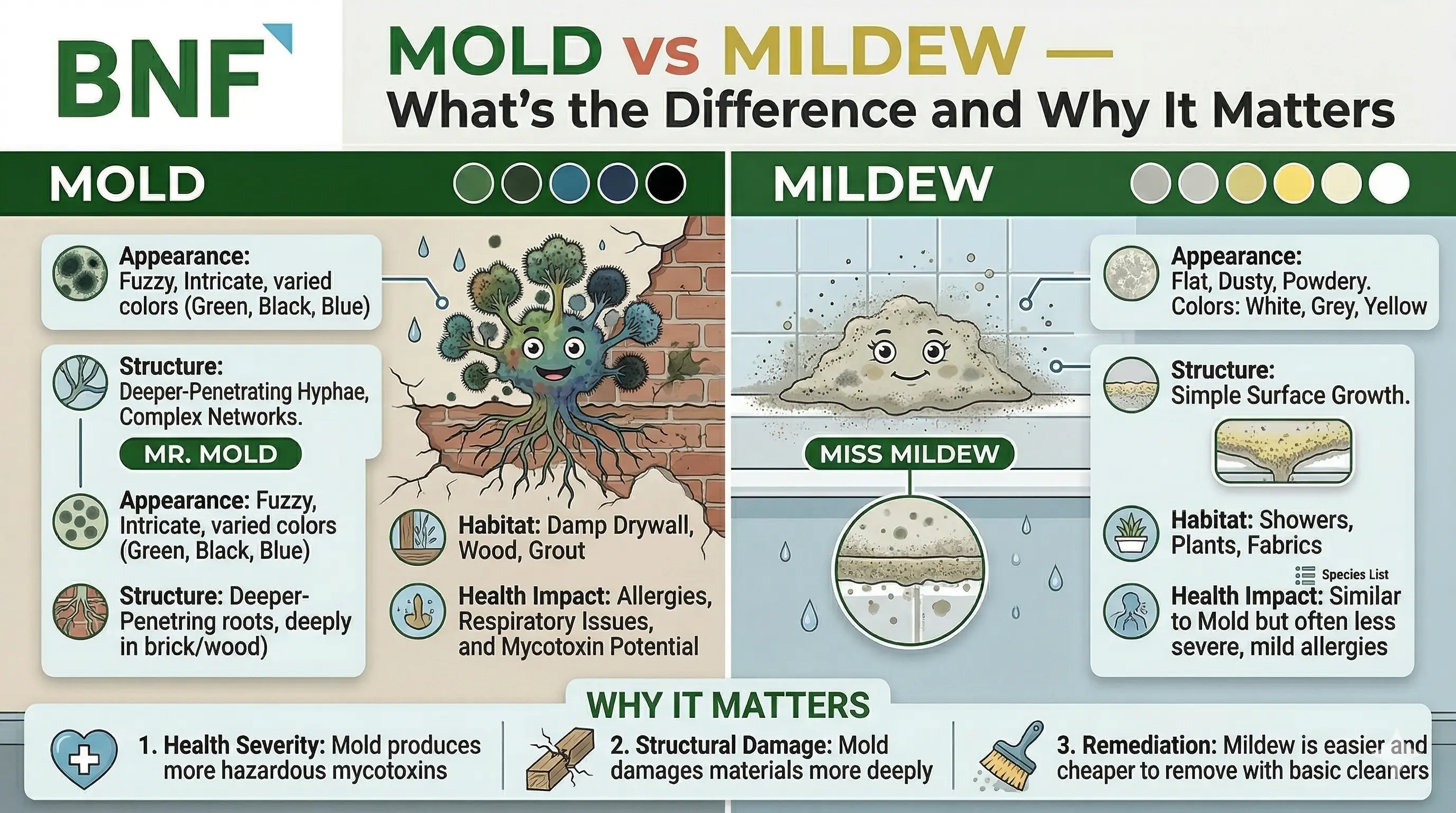
You spot something growing on your bathroom wall, shower grout, or bedroom ceiling. Dark and fuzzy — or flat and powdery? Is it mold? Is it mildew? And does the difference actually matter?
It does. Understanding the difference between mold and mildew could determine whether a $5 cleaning spray fixes your problem — or whether you need a certified professional to assess what's growing inside your walls. Here's what every homeowner in New York, New Jersey, and Connecticut needs to know.
What is the difference between mold and mildew? Mold grows into porous surfaces like drywall and wood, can cause structural damage, and poses serious health risks with prolonged exposure. Mildew grows on surfaces rather than into them, is typically easier to clean, and carries lower health risk. Mold is the more dangerous of the two and requires professional assessment in many cases.
What Is Mold?
Mold is a multicellular fungus that penetrates porous materials — drywall, wood, insulation, carpet — rather than just sitting on top. It reproduces by releasing airborne spores, which is how it spreads through a home and how it affects your health even in rooms where you see no visible growth.
At BNF Consulting, our inspections are led by Dr. Justin Joe, a Certified Industrial Hygienist (CIH) — the highest credential in environmental health. In over a decade of inspections across New York and New Jersey, the most common finding is mold that started small and went unaddressed because homeowners weren't sure what they were looking at.
Common characteristics of mold: Color: Green, black, gray, white, or orange
Texture: Fuzzy, slimy, or velvety — raised from the surface
Smell: Strong musty, earthy odor — often described as a damp basement
Growth pattern: Irregular spreading blotches
Surface behavior: Grows INTO the material, not just on top
What Is Mildew?
Mildew is also a fungus, but one that grows flat on surfaces rather than burrowing into them. It typically appears in the early stages of moisture buildup — before deeper colonization develops. Bathroom tile, shower grout, window sills, and caulking are the most common locations in NYC apartments and older New Jersey homes.
Common characteristics of mildew:
Color: White, gray, or light yellow — may darken over time
Texture: Flat and powdery
Smell: Mild musty odor, less intense than mold
Growth pattern: Spreads in a flat layer across surfaces
Surface behavior: Grows ON TOP of materials, not into them
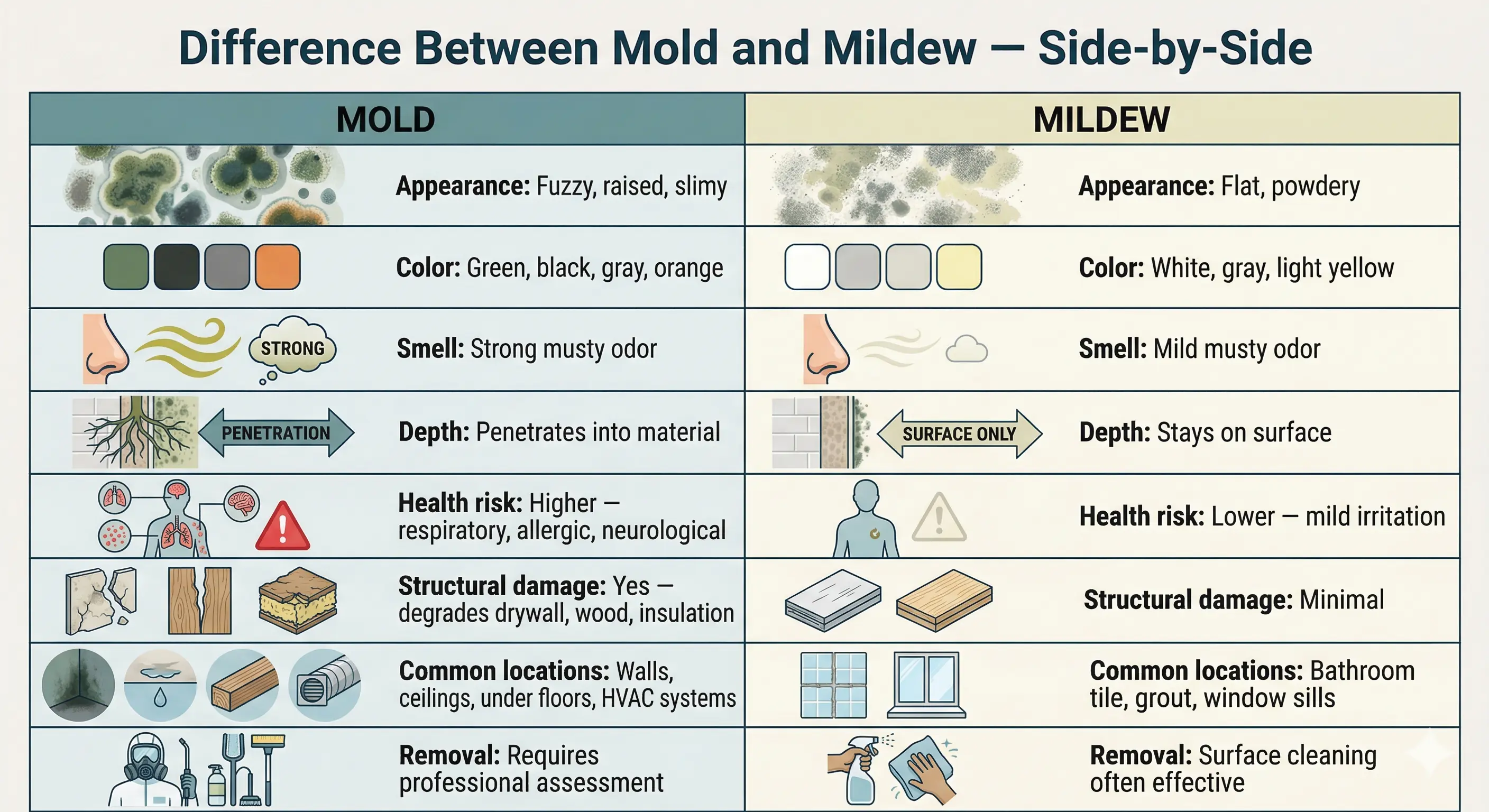
Difference Between Mold and Mildew — Side-by-Side
Mold | Mildew | |
Appearance | Fuzzy, raised, slimy | Flat, powdery |
Color | Green, black, gray, orange | White, gray, light yellow |
Smell | Strong musty odor | Mild musty odor |
Depth | Penetrates into material | Stays on surface |
Health risk | Higher — respiratory, allergic, neurological | Lower — mild irritation |
Structural damage | Yes — degrades drywall, wood, insulation | Minimal |
Common locations | Walls, ceilings, under floors, HVAC systems | Bathroom tile, grout, window sills |
Removal | Requires professional assessment | Surface cleaning often effective |
Signs of Mold vs Mildew — How to Tell Them Apart
This is where most homeowners get it wrong. Here are the diagnostic signs to look for before calling anyone:
Signs you are likely dealing with mildew:
Flat, powdery growth — white or gray — on tile, grout, or caulk
Wipes away cleanly with a household cleaner
Located in a predictable high-humidity spot (shower, window sill)
No strong musty odor in the broader room
Signs you are likely dealing with mold:
Raised, fuzzy, or slimy growth — especially if dark green or black
Does NOT wipe off cleanly, or returns within a few days of cleaning
Located on drywall, wood, ceiling tiles, or baseboards
Strong musty smell even when no growth is visible
Accompanied by peeling paint, bubbling wallpaper, or water staining
Family members experiencing unexplained congestion, headaches, or fatigue
The simple test: Dab a drop of household bleach on the spot. If it lightens within 1–2 minutes, it is likely mildew. If the color doesn't change, it is likely mold. Either way — if it keeps coming back, that is your signal to call BNF Consulting at (914) 297-8335.
Black Mold vs Mildew — The Most Dangerous Comparison
"Black mold" typically refers to Stachybotrys chartarum — a dark greenish-black mold that develops on cellulose-rich materials (drywall, ceiling tiles, wood) after prolonged moisture exposure. It is linked to serious health effects including chronic respiratory issues, fatigue, and neurological symptoms with long-term exposure.
Mildew is never black in its early stages. If what you are seeing is dark, raised, and fuzzy — it is not mildew.
Black mold vs mildew at a glance:
Black mold: dark greenish-black, fuzzy or slimy, strong musty odor, appears on drywall or wood after water damage or flooding.
Mildew: white or gray, flat and powdery, found on tile, grout, and non-porous surfaces
If you suspect black mold anywhere in your home — particularly after a leak, flooding, or water damage — do not disturb it. Disturbing mold releases spores into the air and can spread contamination to unaffected areas of your home.
Mold vs Mildew on Walls — What It Means
Mold on walls is almost always a sign of a moisture problem behind the surface — a slow pipe leak, condensation buildup inside the wall cavity, or water intrusion from outside. It typically appears as irregular blotches, sometimes with peeling paint or a slight raised texture. The wall surface is just where you see it — the actual growth may extend much further inside.
Mildew on walls is usually flat, near poorly ventilated areas like window frames or exterior-facing corners, and responds to surface cleaning. If the growth is flat, white or gray, and confined to a high-humidity area, mildew is the more likely culprit.
If wall growth is dark, raised, or spreading — or if it returns after cleaning — have it professionally assessed before painting over it or attempting removal.
Mold vs Mildew in the Bathroom
Bathrooms are the most common location for both mold and mildew in New York City apartments and New Jersey homes. Inadequate exhaust ventilation, aging grout, and older plumbing create ideal conditions for fungal growth.
Bathroom mildew is typically found on grout lines, caulking, and the lower portion of tile — flat, white or gray, and contained to the wet zone.
Bathroom mold goes further. If you see growth spreading onto the drywall above the tile line, forming on the ceiling in blotchy dark patterns, or appearing around the base of the toilet or vanity — that is mold territory. Bathroom mold often indicates a ventilation failure or a slow leak inside the wall.
A bathroom that smells musty even after cleaning is one of the clearest signs of mold growing somewhere you cannot see it.
When to Stop Cleaning and Start Testing
Surface mildew on bathroom tile can often be addressed with a mold-killing cleaner. But professional mold inspection is the right call when:
Growth has returned multiple times after cleaning
You can smell mold but cannot find the source
Water damage has occurred — even years ago
A family member has unexplained respiratory symptoms, congestion, or fatigue
You are buying or selling a home in New York or New Jersey
Growth is on drywall, wood, ceiling materials, or inside a wall cavity
BNF Consulting provides certified mold inspection and mold testing across New York City, Westchester, and the surrounding region and throughout New Jersey. Every inspection is led by Dr. Justin Joe, CIH — and because BNF Consulting does testing only, never remediation, our findings are always fully independent.
If you are searching for a mold inspection near me in NYC, Westchester, Brooklyn, Queens, or anywhere in New Jersey — call us at (914) 297-8335 for a free consultation.
Frequently Asked Questions
Q: What is the difference between mold and mildew?
Mold penetrates porous surfaces like drywall and wood, spreads through airborne spores, and can cause serious structural damage and health issues. Mildew grows flat on surfaces, is typically white or gray, and is generally easier to remove. Mold is more dangerous and requires professional assessment in many cases.
Q: What are the signs of mold vs mildew?
Mildew is flat, powdery, white or gray, and wipes away cleanly. Mold is raised, fuzzy or slimy, often dark green or black, does not wipe away easily, and may be accompanied by a strong musty odor or health symptoms in household members.
Q: Is black mold the same as mildew?
No. Black mold (Stachybotrys chartarum) is a specific, dangerous mold associated with prolonged water damage and serious health effects. Mildew is white or gray, flat, and found on surface areas. If growth is dark, fuzzy, and expanding — it is mold, not mildew.
Q: Can I clean mold and mildew myself?
Mildew on tile and grout can often be cleaned with surface products. Mold on drywall, wood, or inside walls should not be disturbed without a professional assessment first — disturbing mold spreads spores and can worsen contamination.
Q: Does mold smell different from mildew? Yes. Mold has a strong, damp, earthy musty odor. Mildew has a lighter musty smell. If your home smells strongly musty with no visible growth, mold may be present inside walls, under flooring, or within your HVAC system.
BNF Consulting provides certified mold inspection and mold testing in New York City, Westchester, New Jersey, and Connecticut. Dr. Justin Joe, CIH, leads all inspections. BNF Consulting does testing only — never remediation. Call (914) 297-8335 or visit askbnf.com.