
Justin H. Joe · March 25, 2026
DIY Mold Test Kits vs Professional Mold Testing — Are DIY Mold Kits Worth It?
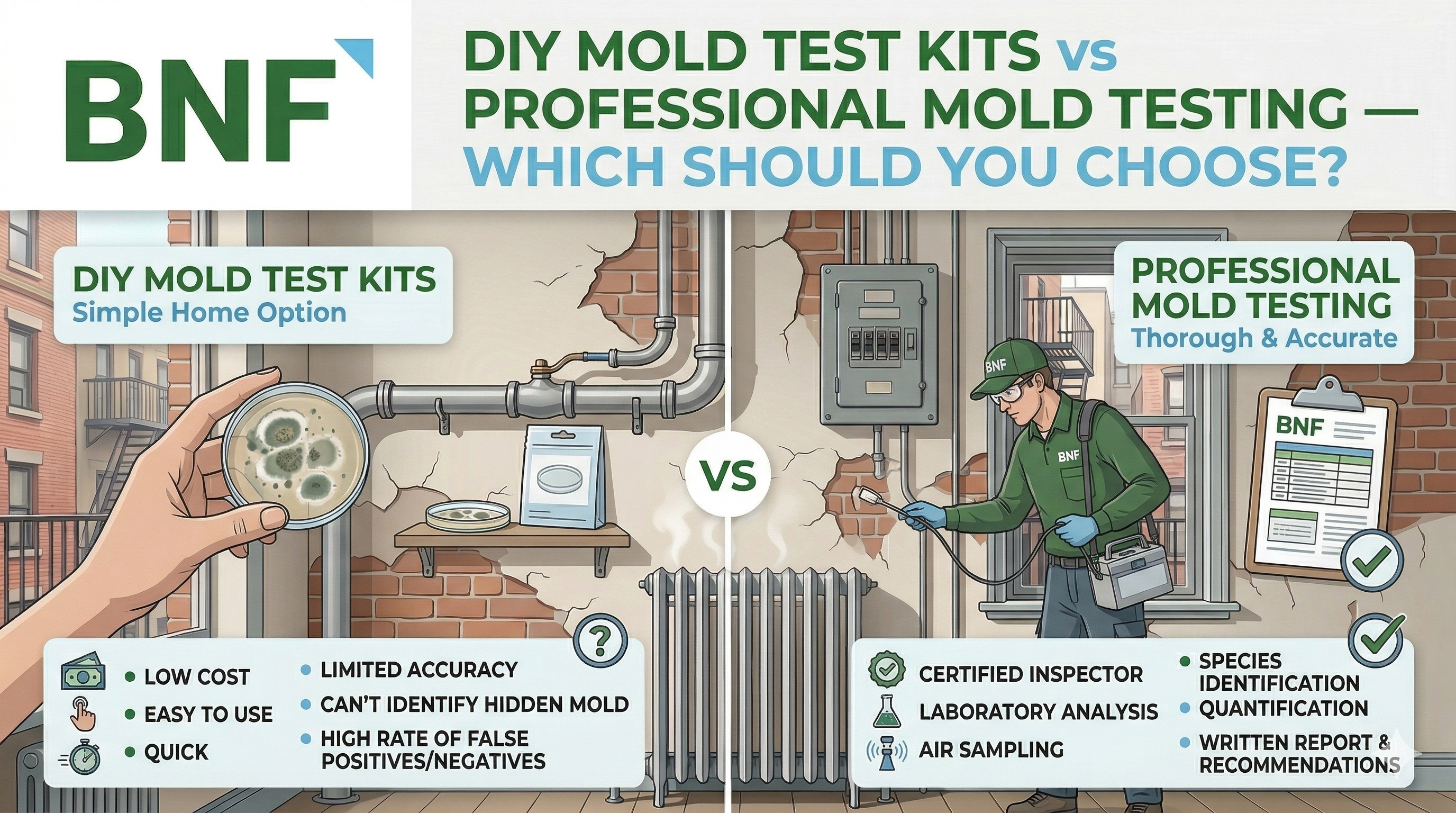
You have seen them at Home Depot. A $30 kit, a petri dish, some instructions, and a promise to tell you whether your home has mold. Compared to a professional mold inspection, the price difference feels enormous. So the question every NYC and NJ homeowner asks is obvious — can a DIY mold test kit do the same job for a fraction of the cost?
The honest answer is: sometimes, but rarely when it actually matters. This guide breaks down exactly what DIY mold test kits can and cannot tell you, when professional mold testing is the only right answer, and how to make the smartest decision for your specific situation.
What Are DIY Mold Test Kits and How Do They Work?
DIY mold test kits are consumer-grade testing products available at hardware stores and online. The most common type is a petri dish kit — you expose the dish to the air in your home for a set period, seal it, and wait for mold colonies to grow. Some kits include a lab submission option where you mail the sample for additional analysis.
The basic process sounds straightforward. But understanding what that petri dish is actually measuring — and what it is not — is where most homeowners get misled.
What a DIY mold test kit measures: The kit detects whether mold spores are present in the air. That is it. Mold spores are present in virtually every indoor environment on earth. The question is never whether mold exists — it is whether the concentration is elevated, what species are present, and where the source is.
A DIY kit answers none of those questions.
Are Home Mold Test Kits Accurate?
This is the most searched question around DIY mold testing — and the data is not flattering for the kits.
The accuracy problem: Home mold test kits are notoriously inconsistent. Studies and independent reviews have repeatedly shown that petri dish kits produce false negatives — missing real mold problems — and false positives — flagging normal background spore levels as a problem. The reason is simple: petri dish culture methods favor certain fast-growing mold species and completely miss others, including some of the most toxic varieties.
Are home mold test kits reliable? For ruling out a serious mold problem — no. For giving you a definitive answer about what species are present and at what concentration — absolutely not.
The lab fee problem: Many DIY kits are marketed as cheap but the real cost adds up fast. The kit itself runs $10-$50. The lab analysis — which you need for any meaningful result — adds another $30-$150. By the time you have a result, you have spent $50-$200 on data that is still not actionable.
A professional mold inspection from BNF Consulting provides air sampling, surface sampling, accredited lab analysis, species identification, concentration levels, moisture source identification, and a written report — for a comparable investment that actually tells you what to do next.
What DIY Mold Test Kits Cannot Tell You
This is the critical section that kit manufacturers would rather you did not read carefully.
DIY kits cannot identify the mold source. Knowing mold is present means nothing without knowing where it is coming from. Is it in the HVAC system spreading spores throughout every room? Behind the bathroom wall where a slow pipe leak has been feeding a colony for six months? Under the flooring from a basement flood? A petri dish cannot answer any of these questions. Without source identification, any remediation you attempt will be incomplete and the mold will return.
DIY kits cannot measure concentration levels accurately. The difference between background mold levels and a genuine indoor air quality problem is concentration. Professional air sampling using spore trap cassettes captures an exact count of spores per cubic meter of air — a standardized, reproducible measurement. A petri dish culture is a qualitative observation at best.
DIY kits cannot identify toxic mold species reliably. Stachybotrys chartarum — black mold — requires specific laboratory analysis methods to identify correctly. Standard petri dish culture methods used in DIY kits are poor at detecting Stachybotrys because it is a slow-growing species that gets outcompeted by faster-growing molds in culture. If you specifically need to rule out toxic black mold, a DIY kit is the wrong tool.
DIY kits produce no legally usable documentation. If you are a NYC renter dealing with a landlord dispute over mold, filing an HPD complaint, making an insurance claim, or involved in a real estate transaction — a DIY kit result is worthless. Courts, insurance companies, HPD, and real estate attorneys require reports from certified professionals. A BNF Consulting mold inspection report is accepted for all of these purposes.
When a DIY Mold Test Kit Might Be Enough
Fairness matters here. There are limited situations where a DIY kit is a reasonable starting point.
If you are simply curious about whether any mold spores are circulating in a specific room — with no health symptoms present, no visible staining, and no past water damage — a basic DIY test can satisfy that curiosity inexpensively.
If you are a renter wanting to document that you raised a concern before formally notifying your landlord — a DIY test creates a basic paper trail, though it will not carry weight in any official proceeding.
That is genuinely the extent of the appropriate use case for DIY mold test kits. If any of the following apply to your situation, a professional mold inspection is not optional — it is the only appropriate response.
When You Absolutely Need Professional Mold Testing
Before buying or selling a home in NYC or NJ. Pre-1978 properties in Brooklyn, Queens, the Bronx, Bergen County, and throughout New Jersey carry significant mold risk from aging plumbing and decades of moisture accumulation. A professional mold inspection report protects buyers from inheriting a serious problem and gives sellers documented evidence of a clean property.
When health symptoms are present. Chronic respiratory issues, persistent headaches, fatigue, or worsening allergies that improve when you leave your home are classic indicators of indoor mold exposure. A DIY kit cannot tell you whether elevated mold levels are causing your symptoms. Professional air sampling can.
After any water damage or flooding. Mold begins growing within 24 to 48 hours of water exposure. After a pipe burst, basement flood, roof leak, or storm damage — professional mold testing is the only way to confirm whether contamination has occurred before you close up walls and flooring.
Before or after mold remediation. If you have had mold removed, professional post-remediation testing — also called clearance testing — confirms the work was successful. No remediation contractor should sign off on a job without independent post-remediation verification from a separate testing firm. BNF Consulting provides clearance testing throughout NYC and New Jersey.
For NYC landlord compliance and tenant disputes. Under NYC Local Law 55, landlords are required to address indoor allergen hazards including mold. If you are a tenant with mold in your apartment, a professional inspection report from BNF Consulting is the documentation you need to file an HPD complaint or pursue legal remedies.
Professional Mold Testing — What Actually Happens
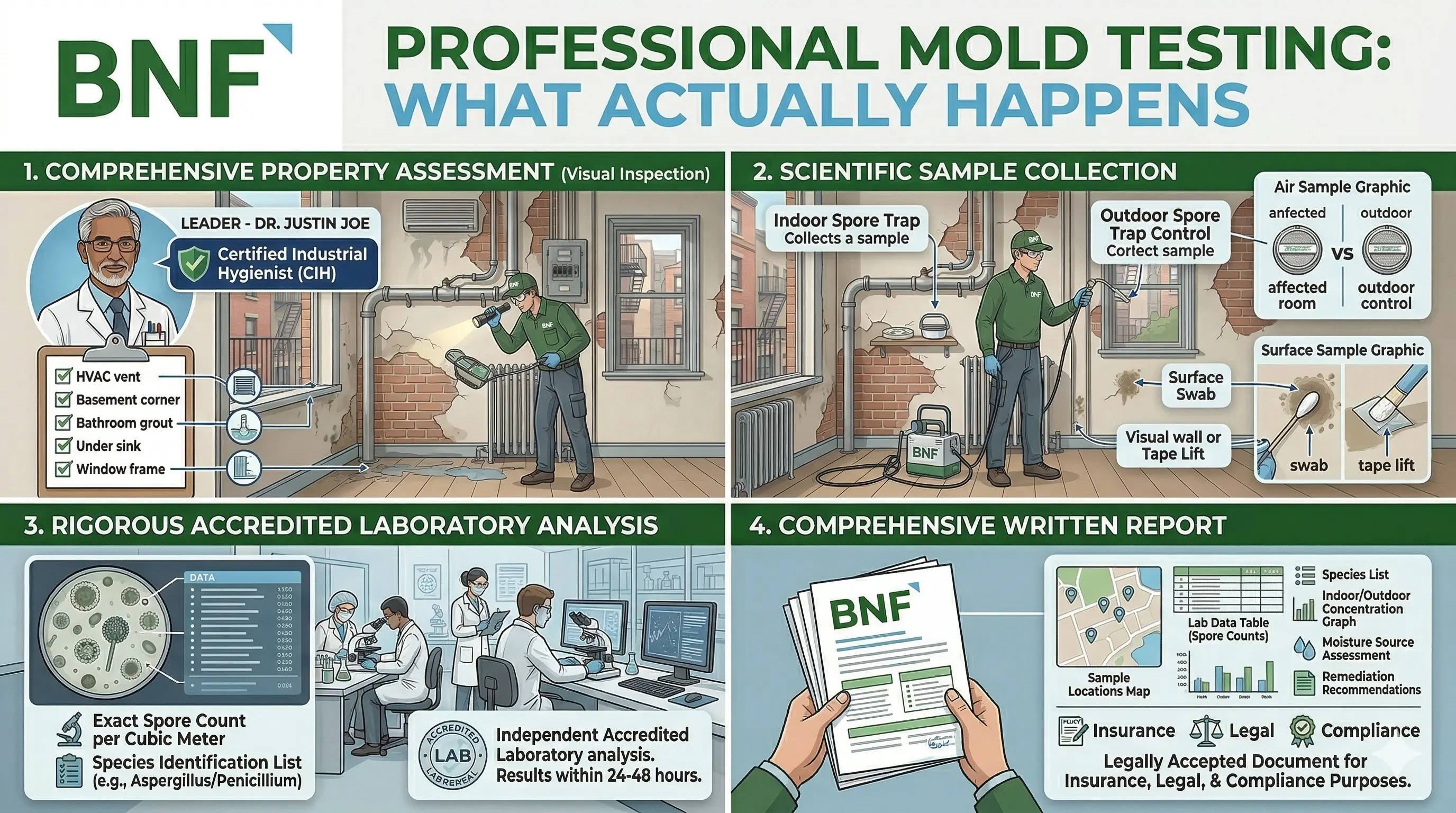
Understanding what a professional mold inspection involves makes the value comparison obvious.
BNF Consulting's certified mold inspectors — led by Dr. Justin Joe, a Certified Industrial Hygienist (CIH) — conduct a comprehensive assessment of your property:
Visual inspection — systematic examination of all high-risk areas including HVAC systems, basement, bathrooms, under sinks, around windows, and any areas with past water damage.
Air sampling — spore trap cassettes collect air samples from affected rooms and an outdoor control sample. Laboratory analysis provides an exact spore count per cubic meter with species identification.
Surface sampling — tape lift or swab samples from suspect staining confirm whether visible growth is mold and identify the specific species.
Accredited laboratory analysis — all samples are analyzed by an independent accredited laboratory. Results returned within 24 to 48 hours.
Written report — comprehensive report including sample locations, laboratory results, species identification, concentration comparison to outdoor baseline, moisture source assessment, and specific remediation recommendations.
This is the difference between knowing mold spores exist somewhere in your home and knowing exactly what species is present, at what concentration, in which rooms, from which source — with a legally accepted document that you can use for insurance, legal, and compliance purposes.
Cost Comparison — DIY vs Professional
DIY Kit | BNF Professional Inspection | |
Upfront cost | $10-$50 | $300-$600 |
Lab fees | $30-$150 additional | Included |
Total cost | $40-$200 | $300-$600 |
Species identification | Limited/unreliable | Full accredited lab analysis |
Concentration measurement | None | Spores per cubic meter |
Source identification | None | Full moisture assessment |
Legally accepted report | No | Yes |
Insurance/HPD use | No | Yes |
Actionable next steps | No | Yes |
When you factor in the hidden lab fees and the fact that DIY results are rarely actionable, the cost difference is far smaller than it first appears — and the value difference is enormous.
Frequently Asked Questions
Are home mold test kits accurate enough to use?
For basic curiosity testing with no health symptoms and no water damage history, a DIY kit can provide a rough answer. For any situation involving health concerns, real estate transactions, insurance claims, or landlord disputes — no. Professional testing by a certified mold inspector is the only appropriate tool. Call BNF Consulting at (914) 297-8335.
How do DIY mold test kits work?
Most DIY kits use petri dish culture methods — you expose the dish to air, seal it, and observe whether mold colonies grow. Some include lab submission for additional analysis. The fundamental limitation is that culture methods favor fast-growing species and miss others, cannot measure concentration, and cannot identify the mold source.
Can a DIY mold test kit detect black mold?
Unreliably. Stachybotrys chartarum — black mold — is a slow-growing species that is frequently missed by standard culture methods used in DIY kits. If you specifically need to rule out toxic black mold, professional air sampling and surface testing by a certified mold inspector is required.
How much does professional mold testing cost in NYC and NJ? BNF Consulting's certified mold inspections typically range from $500 to $1500 depending on property size and the number of samples required. This includes the full inspection, laboratory analysis, and written report — everything you need to take action. Call (914) 297-8335 for a free phone consultation.
The Bottom Line
DIY mold test kits have a place — but that place is narrow. For the situations that actually matter — health symptoms, water damage, real estate transactions, insurance claims, and legal disputes — they fall short in every meaningful way.
BNF Consulting's certified mold inspectors serve all five NYC boroughs and all of New Jersey. Whether you need mold testing in Brooklyn, mold inspection in Queens, or professional mold assessment anywhere in Bergen, Essex, Union, or Hudson County NJ — our CIH-certified team delivers lab-verified results with legally accepted reports and clear next steps.
Do not waste money on a test that cannot give you answers. Call BNF Consulting at (914) 297-8335 for a free phone consultation today. Visit our NYC mold inspection services or New Jersey mold testing page to learn more.
Your safety. Our priority.