
Lead in Drinking Water: How It Gets There and What to Do About It

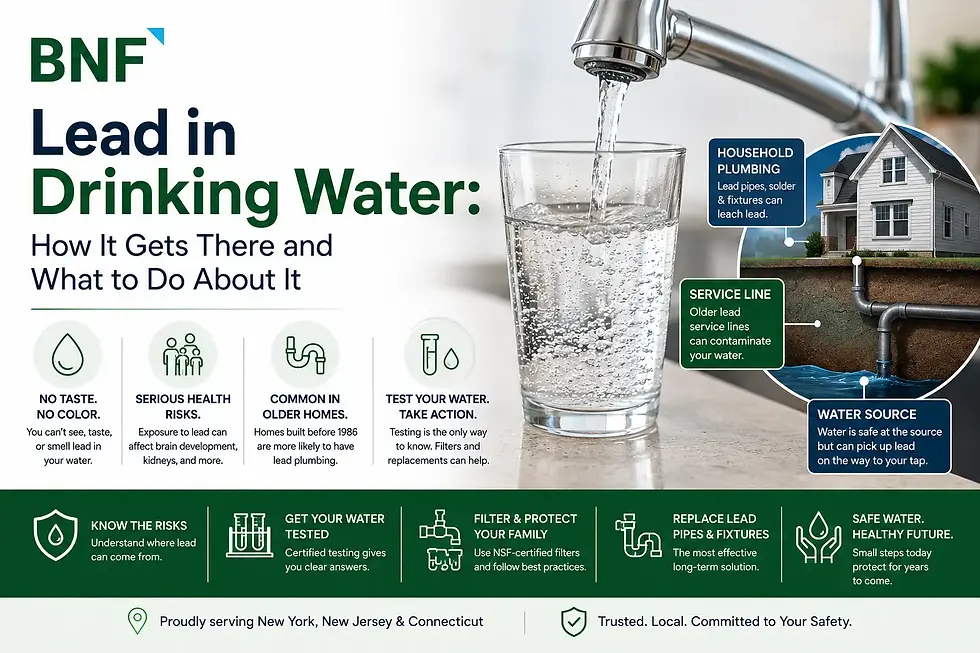
Most people assume their drinking water is safe because it has been treated by a municipal water system. That assumption is understandable, and for the most part it is true. But there is a specific contamination risk that treatment plants cannot fully address, and it comes from inside your own home: lead pipes, lead solder, and lead-containing faucet fixtures that can leach directly into the water you drink every day.
In May 2026, the EPA announced $2.9 billion in new funding to help states accelerate the replacement of lead service lines across the country. That announcement is a signal of how seriously the federal government takes this problem. But it is also a reminder that tens of millions of homes are still connected to aging plumbing that has not yet been replaced.
If your home was built before 1986, this is a risk you need to understand.
How Lead Actually Gets Into Drinking Water
Lead does not come from the water source itself. Municipal water is tested and treated before it ever reaches your neighborhood. The problem begins the moment water enters the plumbing system of an older home.
According to the EPA, the most common sources of lead in tap water are:
Lead service lines: The pipe that connects your home to the municipal water main is called a service line. In homes built before 1986, this pipe is frequently made of lead. As water sits in or travels through these pipes, it can corrode the metal and carry lead particles directly to your tap.
Lead solder: Even homes with copper pipes may have been connected using lead solder, which was standard practice in residential plumbing until it was banned in 1986. Over time, the solder corrodes and releases lead into the water flowing past it.
Brass faucets and fixtures: Older brass faucets and chrome-plated fixtures can contain measurable amounts of lead, particularly at the point where water is dispensed.
The rate at which lead leaches into water depends on several factors: the acidity and mineral content of the water, water temperature, how long water has been sitting in pipes, and the condition and age of the plumbing materials. Water that sits in pipes overnight, for example, will almost always have higher lead concentrations than water that has recently been flushed through.
One critical fact that many homeowners do not know: you cannot tell if your water contains lead by looking at it, tasting it, or smelling it. Lead in water is completely invisible. Testing is the only way to know.
The Health Effects: Why There Is No Safe Level
The EPA has set the maximum contaminant level goal for lead in drinking water at zero. Not 5 parts per billion. Not 15. Zero. That number reflects the scientific consensus that there is no level of lead exposure at which health risk disappears entirely.
For children and infants: Children are the most vulnerable group. Their developing nervous systems absorb lead more readily than adult bodies, and the damage it causes is largely irreversible. According to the EPA and CDC, even low levels of lead in children's blood have been linked to:
Reduced IQ and learning disabilities
Behavioral problems and hyperactivity
Slowed physical growth
Hearing problems
Anemia
The CDC currently recommends that public health action be initiated when a child's blood lead level reaches 3.5 micrograms per deciliter, a threshold that reflects how seriously even modest exposure is treated.
Drinking water is a particularly significant exposure route for infants. The EPA estimates that drinking water can account for 20 percent or more of a person's total lead exposure. For infants who are fed formula mixed with tap water, that figure rises to between 40 and 60 percent of total exposure. That means the water going into a baby's bottle is one of the most consequential lead exposure decisions a parent makes every day, often without realizing it.
For pregnant women: Lead stored in a woman's bones, which can accumulate over a lifetime of low-level exposure, is released during pregnancy as the body draws on calcium reserves to support fetal development. This means a pregnant woman can expose her unborn child to lead even if her current environment is completely lead-free. Lead crosses the placental barrier and has been associated with reduced fetal growth and premature birth.
For adults: Adults are not immune. Chronic exposure to lead in drinking water has been linked to high blood pressure, decreased kidney function, cardiovascular disease, and reproductive problems in both men and women. Many adults with mildly elevated blood lead levels have no symptoms they would connect to lead exposure.
The Lead and Copper Rule: What the Regulation Requires
Since 1991, the EPA has regulated lead in drinking water through what is known as the Lead and Copper Rule. The rule requires public water systems to monitor tap water at customer sites and take corrective action if more than 10 percent of samples exceed the action level of 15 parts per billion.
Critically, this regulation covers public water systems, not the private plumbing inside your home. Your water utility is responsible for the main lines and for treating water before it reaches your property line. What happens inside your home's plumbing is your responsibility.
The rule has been revised multiple times, most recently through the 2024 Lead and Copper Rule Improvements (LCRI), which introduced stronger requirements for lead service line identification and replacement. The federal government's $2.9 billion funding announcement in May 2026 is a direct investment in accelerating that replacement process nationally.
However, the pace of replacement varies significantly by municipality. Until your service line and internal plumbing have been confirmed lead-free, the risk remains.
What NY and NJ Homeowners Should Do Right Now
1. Find out if you have a lead service line. Contact your water utility and ask whether the service line connecting your home to the main is made of lead. Many utilities have now mapped their service line materials, though coverage is not universal. The EPA's "Protect Your Tap" guide also provides step-by-step instructions for identifying lead pipes yourself.
2. Flush your pipes before drinking. The longer water sits in pipes, the more lead it may absorb. Before drinking tap water in the morning or after any period of non-use, run the cold tap for at least 30 seconds to two minutes to flush stagnant water from the pipes. The exact time depends on the length and material of your service line.
3. Always use cold water for drinking and cooking. Hot water dissolves lead from pipes and fixtures far more quickly than cold water. Never use hot tap water for drinking, cooking, or making infant formula. Boiling water does not remove lead. It concentrates it.
4. Clean your faucet aerator regularly. Lead particles and sediment can collect in the small screen at the end of your faucet. Clean it regularly to prevent accumulated particles from entering your drinking water.
5. Use a certified filter. If you have confirmed or suspected lead in your water, use a filter that is specifically certified to remove lead. Not all filters do. Look for NSF/ANSI Standard 53 certification. Do not run hot water through the filter and replace cartridges on schedule.
6. Get your water tested. The only way to know the actual lead level in your tap water is to test it. State-certified laboratories can test your water for between $20 and $100. BNF Consulting provides professional lead water testing across New York and New Jersey as part of our comprehensive lead inspection services.
When to Get Professional Lead Testing
A professional lead inspection goes beyond a basic water test. At BNF Consulting, our certified inspectors assess all potential lead sources in your home, including paint, dust, soil, and water, and provide a complete picture of your family's exposure risk.
Professional testing is particularly important if:
Your home was built before 1986
You have an infant or child under six in the home
A household member is pregnant or planning to become pregnant
You have never had your water tested for lead
Your neighborhood has older infrastructure or ongoing construction near water mains
Your utility has notified you of lead service line activity in your area
BNF Consulting is led by Dr. Justin Joe, Certified Industrial Hygienist (CIH) and PhD, with over a decade of environmental health experience across New York, New Jersey, and Connecticut. We are a testing-only firm. Our results are objective because we have no financial interest in whether remediation is needed.
Call us at (914) 297-8335 or request an inspection here.
Related Reading
Frequently Asked Questions
How does lead get into drinking water? Lead enters drinking water through corrosion of plumbing materials, not from the water source itself. The most common sources are lead service lines (the pipes connecting a home to the municipal main), lead solder used in older copper plumbing, and older brass faucets and fixtures. Homes built before 1986 are most at risk. Water acidity, temperature, and the amount of time water sits in pipes all affect how much lead is released.
Is there a safe level of lead in drinking water? No. The EPA has set the maximum contaminant level goal for lead in drinking water at zero, reflecting the scientific consensus that no level of lead exposure is without health risk. The current action level of 15 parts per billion is a regulatory trigger for public water systems, not a safety threshold for individuals.
Can you taste or smell lead in water? No. Lead in drinking water is completely colorless, odorless, and tasteless. The only way to confirm whether your water contains lead is to have it tested by a certified laboratory or through a professional inspection.
Does boiling water remove lead? No. Boiling water does not remove lead. In fact, boiling can concentrate lead by reducing the volume of water while leaving the dissolved metals behind. Always use cold water for drinking and cooking, and never use hot tap water for making infant formula.
Who is most at risk from lead in drinking water? Children under six and infants are the most vulnerable, as their developing nervous systems are significantly more susceptible to lead's effects. Pregnant women are also at elevated risk because lead stored in bones is released during pregnancy and can cross the placental barrier. Adults with chronic low-level exposure face risks including high blood pressure, kidney damage, and cardiovascular disease.
How do I know if my home has lead pipes? Contact your water utility and ask about your service line material. Many utilities have mapped their infrastructure. You can also use the EPA's "Protect Your Tap" guide to check yourself. For a complete assessment of all lead sources in your home, including pipes, paint, dust, and water, a professional certified inspection provides the most reliable result. Call BNF Consulting at (914) 297-8335 or schedule here.
BNF Consulting provides certified mold inspection, asbestos testing, and lead testing across New York, New Jersey, and Connecticut. All inspections are led by Dr. Justin Joe, CIH, PhD. We are a testing-only firm. Visit askbnf.com or call (914) 297-8335.


Comments