
Lead Paint Testing in NYC Apartments — What Tenants, Parents, and Landlords Need to Know in 2026

You are living in a New York City apartment. It was built before 1978. Maybe the paint on the windowsill is chipping. Maybe your child just came back from the pediatrician with an elevated blood lead level. Maybe you simply want to know — before something goes wrong — whether the walls around your family contain lead.
The answer to that question does not require guesswork. It requires a test.
Lead paint testing in NYC apartments is available, fast, non-destructive, and in many cases legally required — whether your landlord has told you about it or not. This guide covers everything tenants, parents, landlords, and buyers need to know about lead paint testing in New York City in 2026, including what the law requires, what your rights are, and what to do right now.
Does My NYC Apartment Have Lead Paint?
If your apartment building was constructed before 1978 — and in New York City, most were — lead-based paint is a probability, not just a possibility.
The United States banned lead-based paint for residential use in 1978. New York City has one of the oldest housing stocks in the country. Across Brooklyn, Queens, Manhattan, the Bronx, and Staten Island, the majority of residential buildings predate that ban by decades. In many neighborhoods — Harlem, Flatbush, Ridgewood, Astoria, the South Bronx, Bay Ridge — pre-war construction is the norm, not the exception.
In NYC buildings built before 1960, lead paint is legally presumed to be present unless XRF testing proves otherwise.
The risk is not paint sitting perfectly on a wall. The risk is what happens when that paint deteriorates — when it peels, chips, chalks, or is disturbed. That is when invisible lead dust is created. That dust settles on floors, windowsills, and toys. Children touch it. Children put their hands in their mouths.
There is no safe level of lead exposure for children under six.
What Lead Exposure Actually Does — and Why 2026 Is Different
Lead poisoning in children does not announce itself with obvious symptoms. It is cumulative — building silently over months or years of low-level daily exposure. By the time a blood test confirms elevated lead levels, neurological damage has often already occurred.
The effects are not temporary. Lead exposure in early childhood causes:
Permanent reduction in IQ
Learning disabilities and attention disorders
Behavioral problems and impulse control issues
Delayed development — language, motor skills, cognitive function
For adults, prolonged exposure is linked to high blood pressure, kidney damage, and neurological deterioration. For pregnant women, lead exposure increases the risk of miscarriage, premature birth, and developmental problems in the child.
Why 2026 Is an Active Enforcement Year
New York City's Local Law 31 required all pre-1960 residential buildings to complete XRF lead paint testing of every unit and common area by August 9, 2025. That deadline has passed.
As of 2026, HPD has moved from education and implementation into active enforcement. Buildings without completed XRF testing records are now considered non-compliant by default. HPD is auditing, issuing violations, and escalating penalties — particularly in buildings where children under six reside.
If you are a tenant and your landlord has not completed required XRF testing, your building may currently be in violation of New York City law.
Your Rights as a Tenant in a NYC Apartment
This is the section most environmental blogs skip. Here is what New York City law actually gives you as a renter.
You have the right to receive a lead paint disclosure before signing your lease. Federal law requires landlords of pre-1978 properties to provide tenants with the EPA pamphlet "Protect Your Family from Lead in Your Home" and disclose any known lead hazards before a lease is signed.
You have the right to an annual notice from your landlord. Every year between January 1 and January 16, landlords of covered NYC buildings must provide tenants with a written notice asking whether a child under six lives in the unit. This is required under Local Law 1. If you have never received this notice, your landlord may already be in violation.
You have the right to have lead hazards repaired. If peeling, chipping, or deteriorating paint is present in your apartment — especially on windows, doors, or trim — your landlord is legally required to repair it using certified lead-safe work practices. This is not optional. It is the law.
You have the right to file an HPD complaint. If your landlord refuses to address deteriorating paint or has not complied with Local Law 31 testing requirements, you can file a complaint with HPD at 311 or online at nyc.gov. HPD inspectors will investigate, and violations can escalate quickly to Class C — Immediately Hazardous — status.
You have the right to an independent inspection. You do not need your landlord's permission to arrange an independent lead paint inspection of your apartment. An independent report from a certified inspector carries significant weight with HPD, housing court, and building management.
BNF Consulting does testing only — never remediation. This means our findings are fully independent. We have no financial interest in the outcome of your inspection. What we find is what we report — nothing more, nothing less. → [Learn more: What to Do If Your Landlord Won't Fix Lead Paint in NYC]
Who Needs Lead Paint Testing in NYC — And When
Tenants with Young Children
If you have a child under six living in a pre-1978 NYC apartment and you have not received documentation that the unit has been XRF tested and cleared, arrange an independent inspection now. The exposure window during early childhood is narrow. The neurological damage is irreversible.
Tenants Who See Deteriorating Paint
Peeling paint on window frames and sills. Chipping on door frames or baseboards. Bubbling on walls or ceilings. These are not aesthetic issues — they are active lead dust release points. Do not sand, scrape, or attempt to clean them without professional guidance. Report them to your landlord in writing immediately. → [Learn more: Signs of Environmental Hazards in NYC Apartments]
Tenants Whose Child Has an Elevated Blood Lead Level
If your child's pediatrician has reported an elevated blood lead result, an independent environmental inspection of your home is the most important next step. A certified inspector can identify the specific sources of exposure within the apartment — and a written report from Dr. Justin Joe, CIH carries authority with landlords, HPD, and housing court. Call (914) 297-8335 today.
Home Buyers in NYC
Federal law requires sellers of pre-1978 properties to disclose known lead hazards — but disclosure of what is already known is not an independent assessment of what is actually there. Older buildings across Brooklyn, Queens, Manhattan, and the Bronx routinely produce lead paint findings during professional inspection that sellers were unaware of. A pre-purchase XRF inspection gives buyers documented, independent information before they close. → [Learn more: Environmental Testing Before Buying a Home in NYC]
NYC Landlords
If you own a residential building in New York City constructed before 1960 — or before 1978 with known lead paint — and you have not completed required XRF testing, you are currently non-compliant under Local Law 31. HPD is actively enforcing. Class C violations carry fines of $1,000 to $5,000 per violation. Late compliance is better than no compliance — but it needs to happen now. Call (914) 297-8335 to schedule your building assessment.
XRF Lead Testing vs. Paint Chip Sampling — What's the Difference?
Not all lead testing methods are equal. The method determines how much information you get, how quickly, and what risk the testing process itself creates.
Feature | Paint Chip Sampling | XRF Lead Inspection |
Surface damage | Yes — chip removed from wall | None — fully non-destructive |
Results timeline | 3–5 business days | Immediate, on-site |
Coverage per visit | One surface per sample | Entire apartment in one visit |
Lead dust generated | Yes — during sampling | None |
NYC Local Law 31 compliance | Limited | Yes — required method |
Best for | Single-surface confirmation | Full property risk assessment |
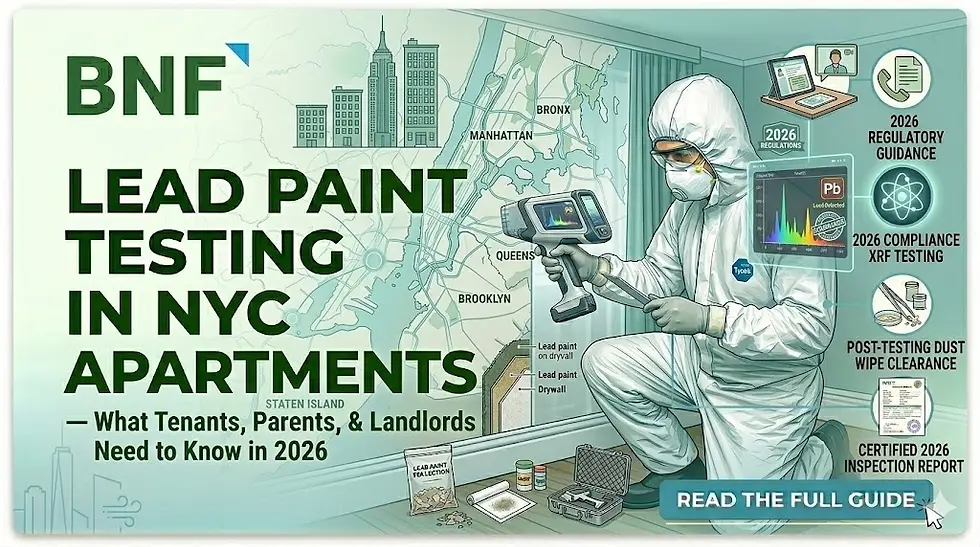
XRF (X-Ray Fluorescence) testing is the gold standard — and the method required by NYC Local Law 31. A handheld XRF analyzer directs a focused X-ray beam at a painted surface and measures the concentration of lead in milligrams per square centimeter. Results are immediate. No surface is damaged. No dust is created.
Every lead paint inspection conducted by BNF Consulting uses XRF technology and is led by Dr. Justin H. Joe, CIH — a Certified Industrial Hygienist, the highest credential available in environmental health. BNF Consulting does testing only, never remediation — ensuring fully independent findings with no conflict of interest. Call (914) 297-8335 to schedule.
Where Lead Paint Hides in NYC Apartments
This is what professional inspectors find most often — and what most tenants don't know to look for.
High-risk surfaces in NYC apartments:
Window channels and sills — the highest-risk surface in most pre-war apartments. Paint wears away continuously every time the window is opened and closed, releasing lead dust directly onto the sill where children's hands rest
Door frames and edges — friction surfaces that generate dust with normal daily use
Interior walls and ceilings — especially in older apartments where original paint layers remain beneath multiple coats
Baseboards and trim — commonly painted multiple times over decades; original lead layers remain below
Kitchen and bathroom surfaces — high humidity areas where paint deterioration accelerates
Common areas — hallways, stairwells, lobbies in pre-1960 buildings are all subject to Local Law 31 testing requirements
If you are in a pre-war NYC apartment and any of these surfaces show peeling, chipping, or chalking — the paint on those surfaces must be treated as lead-containing until tested.
Lead Paint Testing in NYC — Borough by Borough
BNF Consulting provides certified XRF lead paint testing and lead inspections throughout all five NYC boroughs.
Brooklyn Pre-war brownstones and multi-family row houses across Flatbush, Midwood, Ridgewood, Park Slope, Bay Ridge, Sunset Park, Crown Heights, and Bed-Stuy are among the most common settings for lead paint findings in NYC. Brooklyn's dense stock of pre-1940 housing means lead paint is a routine discovery during professional inspection. BNF Consulting NYC LLC serves all of Brooklyn from its Bay Ridge location at 453 85th Street.
Queens Older attached housing in Jackson Heights, Elmhurst, Woodside, Ozone Park, Richmond Hill, Middle Village, Astoria, and Flushing represents a significant lead paint risk for families in pre-1960 apartments and two-family homes. BNF Consulting NYC serves all of Queens from its Forest Hills location at 109-20 Queens Blvd — one of BNF's most active service areas for tenant-initiated lead inspections.
Manhattan Pre-war co-ops and rental buildings across Harlem, Washington Heights, Inwood, the Upper West Side, the Upper East Side, and the Lower East Side consistently produce lead paint findings during professional inspection. Manhattan's density and the age of its housing stock make it one of the highest-risk boroughs for lead paint exposure. BNF provides certified XRF inspection throughout Manhattan.
The Bronx Dense multi-family housing across the South Bronx, Fordham, Tremont, Riverdale, and Morris Heights represents significant Local Law 31 compliance demand — and significant tenant-initiated inspection volume. BNF provides lead paint testing services and XRF inspection across the Bronx.
Staten Island Older single-family and two-family homes throughout Staten Island are frequent subjects of pre-purchase and tenant-initiated lead inspections. BNF provides certified lead paint testing across the borough. Call (914) 297-8335 to schedule.
What NYC Local Law 31 Actually Requires in 2026
New York City's lead paint laws are among the most comprehensive in the country. Here is what applies specifically to NYC apartments in 2026.
Local Law 1 of 2004 (Childhood Lead Poisoning Prevention Act) Requires landlords of multiple dwellings built before 1960 to proactively identify and remediate lead paint hazards in units where children under six reside. Annual inspections, tenant notices, and certified repair using lead-safe work practices are all mandated.
Local Law 31 of 2020 Required XRF testing of all painted surfaces in all dwelling units and common areas of pre-1960 buildings — and pre-1978 buildings with known lead paint — by August 9, 2025. That deadline has passed. Compliance is now enforced, not encouraged.
Local Laws 111, 122, 123, and 127 (2023) Expanded requirements for recordkeeping, common area testing, remediation timelines, and enforcement actions. As of 2025, landlords must submit XRF testing records to HPD whenever a lead hazard or turnover violation is issued.
What this means for tenants in 2026: Your landlord is legally required to have completed XRF testing of your unit. If they cannot produce those records — to you, to HPD, or in housing court — they may be in active violation. An independent inspection from BNF Consulting creates a documented record that protects you, regardless of what your landlord claims.
How Much Does Lead Paint Testing Cost in NYC?
Lead paint inspection cost in NYC varies based on apartment size, the number of surfaces to be tested, and whether Local Law 31 documentation is required.
For a standard apartment or single-family home, lead paint testing near me in NYC typically takes one and a half to three hours from start to finish. XRF inspection cost for a single apartment is significantly lower than most tenants expect — and far less than the cost of lead remediation or, far worse, the medical and developmental consequences of undetected lead exposure.
BNF Consulting provides free consultations to scope the right inspection for your property and give you a clear cost estimate before you commit. Call (914) 297-8335 and speak directly with a certified inspector.
What Happens After the Test?
If no lead is found: Your inspector provides a written report documenting that tested surfaces are below the lead action level. In NYC, this documentation can be filed with HPD for a Lead-Free Exemption — reducing future landlord obligations and giving you documented confirmation that your apartment is safe.
If lead paint is found: Finding lead paint does not mean emergency. It means you now have information. Your BNF report will identify every surface by room, material, and lead concentration level — giving you and your landlord a clear picture of where hazards exist and what action is required. Because BNF does testing only and never remediation, our report is independent and cannot be influenced by any financial interest in recommending removal services. → [Learn more: What Happens If Lead Paint Is Found in Your NYC Apartment]
Schedule Your NYC Apartment Lead Paint Inspection
If you are a tenant in a pre-1978 NYC apartment — particularly if you have a child under six, if you have noticed deteriorating paint, or if your child has received an elevated blood lead result — do not wait for your landlord to act.
An independent inspection from BNF Consulting gives you documented facts about your home. That information protects your family, strengthens any complaint or legal action, and cannot be taken away.
BNF Consulting, Inc. is a certified environmental consulting firm led by Dr. Justin H. Joe, CIH — Certified Industrial Hygienist. We provide XRF lead paint inspection and lead paint testing throughout all five NYC boroughs, Westchester County, Long Island, New Jersey, and Connecticut. We do testing only, never remediation — so our findings are always fully independent.
📞 Call (914) 297-8335 for a free consultation 🌐 Visit www.askBNF.com to learn more 📍 Forest Hills, Queens: 109-20 Queens Blvd #3E, Forest Hills, NY 11375 📍 Brooklyn: 453 85th St, Brooklyn, NY 11209
Don't wait for a blood test to tell you what a lead inspection could have told you today.
BNF Consulting, Inc. | 152 Route 202, #404, Lincolndale, NY 10540 | www.askBNF.com | (914) 297-8335
Frequently Asked Questions
Does my NYC apartment have lead paint? If your building was constructed before 1978, lead-based paint is very likely present. In buildings built before 1960, NYC law legally presumes lead paint exists unless XRF testing proves otherwise. The only way to know for certain is through professional XRF testing.
What is XRF lead testing and how does it work? XRF stands for X-Ray Fluorescence. A handheld analyzer directs X-ray energy at a painted surface and measures the lead concentration in seconds. It is non-destructive — no surface damage, no lead dust generated, results delivered the same day. XRF is the required method for NYC Local Law 31 compliance and the gold standard for lead paint inspection in NYC apartments.
Can I arrange my own lead paint inspection as a tenant? Yes. You do not need your landlord's permission. An independent inspection report from BNF Consulting carries significant weight with HPD, housing court, and building management — and because BNF does testing only and never remediation, the findings are fully independent.
What is the lead paint inspection cost in NYC? Lead paint testing cost in NYC depends on apartment size and the number of surfaces to be tested. BNF Consulting offers free consultations to provide a clear cost estimate before you commit. Call (914) 297-8335.
My child has an elevated blood lead level — what do I do? Contact your child's pediatrician immediately for follow-up blood testing and guidance. Then arrange an independent environmental inspection of your apartment to identify the source. Call BNF Consulting at (914) 297-8335 — we serve all five NYC boroughs and can schedule an inspection quickly.
What is NYC Local Law 31 and does it apply to my building? Local Law 31 requires XRF lead paint testing of all units and common areas in NYC residential buildings built before 1960 — and pre-1978 buildings where lead paint is known or presumed. The testing deadline was August 9, 2025. As of 2026, HPD is actively enforcing compliance and issuing violations to non-compliant buildings.
My landlord says the apartment doesn't have lead paint — should I trust that? Only a professional XRF inspection can confirm that. Visual assessment alone is not reliable — lead paint is often buried beneath multiple layers of newer paint and shows no visible signs until it begins to deteriorate. If your landlord cannot provide documented XRF testing records, the unit should be treated as untested.
How long does a lead paint inspection take in a NYC apartment? A standard apartment inspection typically takes one and a half to three hours, depending on the number of rooms and surfaces. Results are available on-site the same day.


Comments