
Justin H. Joe · April 16, 2026
Lead Paint Testing & XRF Inspection in NYC, Westchester, NJ & CT — What Homeowners, Tenants & Landlords Need to Know
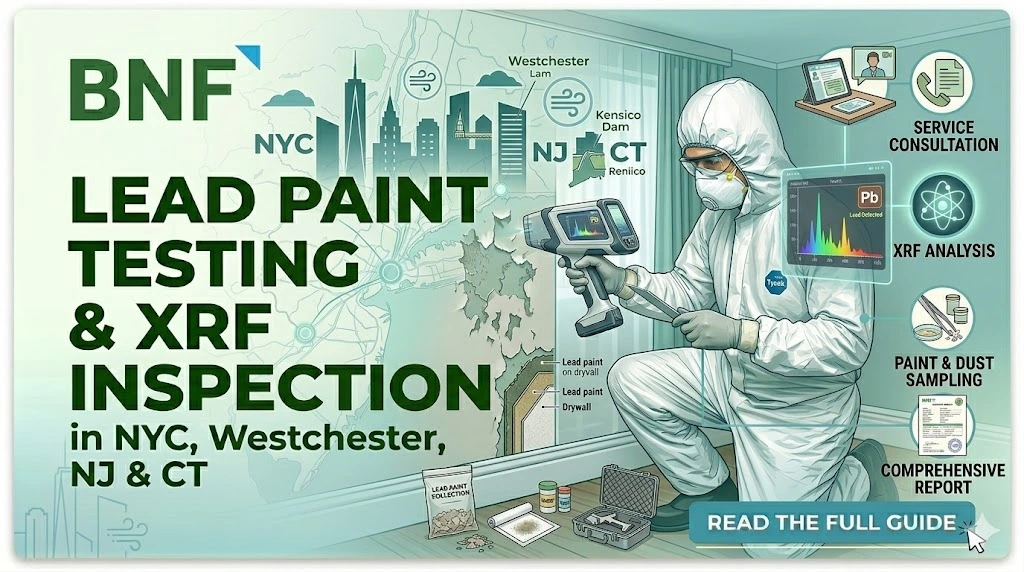
Do you need lead paint testing if your home was built before 1978? If your home was built before 1978, professional lead paint testing is strongly recommended — and in many cases legally required. XRF (X-ray fluorescence) testing is the most accurate, non-destructive method available for detecting lead in painted surfaces. It reads lead concentrations through all paint layers in seconds, produces no dust, and delivers results on-site the same day. BNF Consulting provides certified lead paint testing and XRF inspection across New York City, Westchester County, Long Island, the Hudson Valley, New Jersey, and Connecticut — led by Dr. Justin Joe, CIH. Call (914) 297-8335 for a free consultation.
If your home was built before 1978 — and most homes across New York City, New Jersey, and Connecticut were — lead paint is not a possibility. It is a probability.
The United States banned lead-based paint for residential use in 1978. But in the tri-state area, where pre-war brownstones, mid-century apartment buildings, and Victorian-era single-family homes make up the majority of the housing stock, lead paint in various states of deterioration is one of the most common environmental hazards professional inspectors encounter. In New York City alone, over 60% of residential buildings predate that ban.
The risk is not paint sitting on a wall in perfect condition. The risk is paint that is peeling, chipping, chalking, or being disturbed — by time, by humidity, by renovation, or by the daily friction of a window sliding in its channel.
Do you need lead paint testing before renovation? Lead paint testing is required before any renovation work in properties built before 1978 where painted surfaces will be disturbed. Under the EPA's Renovation, Repair, and Painting (RRP) Rule, contractors must follow lead-safe work practices whenever lead paint may be present. In New York City, this frequently involves XRF inspection to comply with Local Law 31 and EPA RRP regulations simultaneously. Sanding, scraping, or drilling through lead-painted surfaces without prior testing generates invisible dust at concentrations that are dangerous for workers and occupants — particularly children under six.
Lead dust generated from deteriorating paint is invisible, odorless, and extraordinarily dangerous. Here is everything you need to know about lead paint testing, XRF inspection, who needs it and when, and where BNF Consulting provides certified lead testing across the tri-state region.
What Is XRF Lead Testing and Why Is It the Gold Standard?
XRF stands for X-ray fluorescence. An XRF analyzer works by directing a focused beam of X-ray waves at a painted surface. Lead present in the paint absorbs the energy and fluoresces back at a specific, measurable level — which the device reads and quantifies in milligrams per square centimeter. Each surface reading takes seconds. The result is immediate, precise, and requires no damage whatsoever to the surface being tested.
This matters because the alternative — paint chip sampling — requires physically removing a piece of the painted surface and sending it to a lab. That process takes days to produce results, costs more per surface when testing large properties, and creates lead dust in the act of sampling if the paint contains lead. XRF testing produces no dust, no surface disruption, and no debris. It is the method of choice for pre-purchase inspections, Local Law 31 compliance, tenant documentation, and pre-renovation risk assessment across NYC, Westchester, NJ, and CT.
Every XRF lead inspection conducted by BNF Consulting is led by Dr. Justin Joe, CIH — a Certified Industrial Hygienist, the highest credential in environmental health.
Lead Paint Testing vs. XRF Inspection — Understanding the Difference
These two terms are often used interchangeably. They should not be. The method you choose determines how much information you get, how quickly, and at what risk to the property and its occupants.
Feature | Paint Chip Sampling | XRF Lead Inspection |
Surface damage | Yes — chip removed from wall | None — fully non-destructive |
Results timeline | 3 to 5 business days | Immediate, on-site |
Coverage per visit | One surface per sample | Entire property in one visit |
Dust generated | Yes — during the sampling process | None |
NYC Local Law 31 compliance | Limited | Yes — preferred and accepted method |
Best for | Targeted single-surface confirmation | Full property risk assessment |
For homeowners buying a pre-1978 property, landlords managing buildings subject to NYC Local Law 31, and tenants documenting conditions for an HPD complaint or housing dispute, XRF inspection is the right choice in almost every situation. It covers more surfaces, generates no hazard during testing, and delivers results the same day.
Who Needs Lead Paint Testing in NYC, NJ & CT?
Lead paint testing is not one-size-fits-all. The reason you need it determines the scope of the inspection, the method required, and how the results will be used.
If you are buying a home built before 1978, a professional lead inspection before you close is one of the most important environmental steps you can take. Federal law requires sellers to disclose known lead hazards — but disclosure of what is already known is not an independent assessment of actual conditions. Older neighborhoods across Brooklyn, Queens, Manhattan, Bergen County, Westchester County, and Fairfield County consistently produce lead paint findings during professional inspection, often in areas sellers were unaware of. A pre-purchase XRF inspection gives buyers documented, independent information before they are bound to the property.
If you are a landlord in New York City, NYC Local Law 31 may apply to your building right now. The law requires XRF testing of all painted surfaces in residential buildings constructed before 1960 — and before 1978 in buildings where a child under six lives in any unit. Compliance deadlines have been rolling since 2020. Landlords across all five boroughs who have not yet completed required XRF inspections are exposed to active HPD violations and financial penalties.
If you are a tenant with a child under six in a pre-war apartment, and you have noticed peeling paint, deteriorating windowsills, or your child has received an elevated blood lead level from their pediatrician — an independent professional inspection is the most important next step. A written report from a certified inspector like Dr. Justin Joe, CIH carries significant weight with property managers, HPD, and housing court. Because BNF Consulting does testing only and never remediation, our findings are fully independent — there is no financial interest in the outcome.
If you are planning a renovation in a pre-1978 home, lead paint testing before work begins is not optional — it is legally required under the EPA's RRP Rule whenever painted surfaces may be disturbed.
NYC Local Law 31 — What Every NYC Landlord Needs to Know
Local Law 31 of 2020 amended New York City's existing Local Law 1 and significantly expanded lead paint testing requirements for building owners. The compliance stakes are real.
Buildings constructed before 1960 are subject to mandatory XRF testing of all painted surfaces in dwelling units and common areas — regardless of whether children live in the building. Buildings constructed before 1978 are covered if any child under six resides in a unit. Every painted surface must be tested: walls, ceilings, window frames, sills, doors, trim, and all other painted components throughout dwelling units and common areas.
XRF testing is the required method. Paint chip sampling is only accepted where XRF produces an inconclusive result on a specific surface. All results must be documented and retained. Building owners must provide documentation to HPD upon request and update records when conditions change.
Landlords managing buildings across Brooklyn, Queens, the Bronx, Manhattan, and Staten Island who have not completed required XRF inspections are currently non-compliant. BNF Consulting provides Local Law 31 XRF inspections throughout all five NYC boroughs and can provide the documentation required for HPD compliance. Call (914) 297-8335 to discuss your building.
The Health Risks of Lead Paint — Why This Is Not a Precaution, It Is a Priority
Lead poisoning does not announce itself. In children, it is cumulative — building up over months or years of daily low-level exposure, frequently without any acute symptoms until neurological damage has already occurred.
Children under six are the most vulnerable population. Lead disrupts normal brain and nervous system development during the critical early years of life. Blood lead levels that were once considered acceptable have now been conclusively linked to measurable reductions in IQ, attention disorders, learning disabilities, and behavioral problems. The CDC has stated clearly that there is no safe blood lead level in children.
The primary route of exposure is not touching a painted wall. It is lead dust — generated by deteriorating paint on windows, doors, and trim, particularly on friction surfaces where paint is constantly worn away during normal use. Children are exposed through ordinary hand-to-mouth activity during play. A child does not need to eat paint chips to be poisoned. They need only spend time on a floor where invisible lead dust has settled from a deteriorating windowsill above.
For adults, prolonged high-level lead exposure is associated with hypertension, kidney damage, and reproductive effects. Pregnant women with lead exposure face an elevated risk of adverse birth outcomes. In renovation settings, acute dust exposure during sanding or scraping of lead-painted surfaces without proper containment creates significant risk for both workers and occupants who remain in the home.
Lead is one of three critical environmental hazards commonly found together in pre-1978 properties across the tri-state area. If you are arranging a lead inspection, it is worth understanding whether asbestos or mold may also be present — particularly in older buildings undergoing renovation or with a history of water damage. See our complete guide to asbestos testing in NYC, NJ & CT and our overview of mold inspection services across NYC, NJ & CT for a full picture of what a professional environmental assessment covers.
Lead Paint Testing Across NYC — By Borough
New York City's pre-war housing stock means lead paint is a consistent finding across all five boroughs. BNF Consulting provides XRF lead inspection and lead paint testing throughout the city.
In Brooklyn, pre-war brownstones and multi-family row houses across Midwood, Ridgewood, Park Slope, Bay Ridge, and Sunset Park frequently contain lead paint in varying states of deterioration — particularly on original windows, doors, and trim. Lead paint inspector Brooklyn demand reflects the age and density of the borough's housing stock. BNF serves the entire borough from its NYC LLC location at 453 85th Street.
In Queens, older attached housing in Jackson Heights, Elmhurst, Ozone Park, Richmond Hill, and Middle Village represents a significant lead paint exposure risk for families in pre-1960 apartments and two-family homes. BNF provides XRF inspection and lead testing throughout Queens from its Forest Hills location at 109-20 Queens Blvd.
In Manhattan, pre-war co-ops and rental buildings across the Upper West Side, Harlem, Washington Heights, Inwood, and the Lower East Side are among the most common settings for lead paint findings in NYC. BNF provides certified XRF inspection throughout Manhattan.
In the Bronx, dense multi-family housing — particularly in the South Bronx, Fordham, and Riverdale — represents significant Local Law 31 compliance demand. BNF provides lead testing services and XRF inspection across the Bronx.
In Staten Island, older single-family and two-family homes throughout the borough are frequent subjects of pre-purchase and tenant-initiated lead inspections. BNF provides certified lead testing across Staten Island. Call (914) 297-8335 to schedule.
Lead Paint Testing in Westchester County and the Hudson Valley
Westchester County has one of the highest concentrations of pre-war housing stock in the entire metro area outside of NYC itself — and XRF lead testing in Westchester is one of BNF Consulting's most active service areas. BNF Consulting Westchester LLC is based in White Plains at 301 Quarropas Street and provides XRF lead inspection and lead paint testing across all of Westchester County — including White Plains, Yonkers, Scarsdale, New Rochelle, Mount Vernon, Tarrytown, Dobbs Ferry, Larchmont, and throughout Northern Westchester.
In the broader Hudson Valley, BNF Consulting provides certified lead testing across Putnam County (Mahopac, Brewster, Carmel, Patterson, Pawling), Dutchess County (Poughkeepsie, Rhinebeck, Millbrook, Red Hook), Rockland County (New City, Nyack, Spring Valley), Orange County (Newburgh, Middletown, Monroe), and Ulster County (Kingston, New Paltz, Woodstock). Certified lead testing in the Hudson Valley is available through BNF Consulting's Somers location. Call (914) 297-8335 for service in your area.
Suffolk County and Nassau County Lead Testing
Suffolk County lead testing represents one of the most significant unmet needs in BNF Consulting's current service area. The older housing stock across Nassau and Suffolk counties, combined with the coastal humidity that accelerates paint deterioration in Long Island's pre-war and mid-century homes, makes lead paint testing a consistent priority for homeowners, landlords, and buyers across both counties. BNF Consulting provides XRF lead inspection and lead paint testing across Nassau County and Suffolk County. Call (914) 297-8335 to arrange a certified inspection.
Lead Paint Inspection in New Jersey
New Jersey's older housing stock — particularly across Bergen County, Essex County, Passaic County, Union County, Hudson County, and Morris County — contains significant concentrations of pre-1940 housing where lead paint is a routine finding during professional inspection. BNF Consulting NJ operates from its Englewood location at 240 E Palisade Avenue and provides certified XRF lead inspection and lead paint testing throughout New Jersey.
In Bergen County, BNF serves Englewood, Teaneck, Hackensack, Fort Lee, Paramus, and Mahwah. In Essex County, service covers Newark, Montclair, Livingston, Millburn, and Maplewood. BNF also provides lead paint inspection throughout Passaic County, Union County, Hudson County, and Morris County. For a full overview of New Jersey service areas, visit our New Jersey location page.
Lead Paint Testing in Connecticut
Connecticut's older colonial and Victorian-era housing — particularly across Fairfield County, New Haven County, and Litchfield County — presents a persistent lead paint risk for homeowners and buyers. BNF Consulting CT provides XRF lead inspection and lead paint testing throughout Connecticut, with service concentrated in Fairfield County (Stamford, Greenwich, Norwalk, Bridgeport, Danbury), New Haven County (New Haven, Waterbury, Milford, Hamden), and Litchfield County (Torrington, New Milford, Winsted). For Connecticut service, call (914) 297-8335.
When to Arrange a Lead Paint Inspection
No amount of visual inspection tells you whether paint contains lead. Paint can look perfectly intact and still contain lead at concentrations that pose a serious risk the moment it begins to deteriorate or is disturbed by renovation. A professional XRF inspection is the only way to know with certainty.
If you are searching for lead paint testing near me in NYC, Westchester, NJ, or CT — or looking for an XRF inspection cost estimate before committing — BNF Consulting offers free consultations to scope the right inspection for your property. Lead inspection cost in NYC varies based on property size, number of surfaces, and whether Local Law 31 documentation is required. Lead paint testing in an apartment in NYC typically costs less than a full multi-unit building assessment. Call (914) 297-8335, and we will give you a clear picture before you schedule anything.
Arrange a professional inspection when any of the following apply:
You are purchasing a home built before 1978 in NYC, Westchester, New Jersey, or Connecticut
You are a landlord managing a pre-1960 NYC building subject to Local Law 31 compliance
You are a tenant with a child under six in a pre-war apartment with deteriorating paint or windows
Your child has received an elevated blood lead test result and you need to identify the source
You are planning renovation or remodeling work in any pre-1978 property
You are selling a pre-1978 home and want to document lead paint status before listing
A landlord has refused to address deteriorating paint and you need independent documentation for HPD or housing court
Do not attempt to sand, scrape, or remove deteriorating paint in a pre-1978 property before lead testing has been completed. Disturbing painted surfaces without knowing their lead content generates dust at concentrations far above safe levels and significantly increases exposure for anyone in the property — particularly children.
BNF Consulting provides certified lead paint testing and XRF inspection for homeowners, tenants, landlords, and property managers throughout the tri-state area. Every inspection is led by Dr. Justin H. Joe, CIH — and because BNF Consulting does testing only, never remediation, our findings are always fully independent. Call (914) 297-8335 for a free consultation or visit askbnf.com.
Service Areas: New York City — NYC | Brooklyn | Queens | Manhattan | Bronx | Staten Island | Nassau County | Suffolk County | Westchester County | Putnam County | Rockland County | Orange County | Dutchess County | Ulster County | Sullivan County | Greene County | Columbia County | New Jersey | Bergen County | Essex County | Passaic County | Union County | Hudson County | Morris County | Connecticut | Fairfield County | New Haven County | Litchfield County
Frequently Asked Questions
Q: What is XRF lead testing, and how does it work? XRF stands for X-ray fluorescence. An XRF analyzer directs X-ray energy at a painted surface and measures the fluorescent energy re-emitted by lead in the paint, producing a result in milligrams per square centimeter within seconds. It is non-destructive — no surface damage, no lead dust generated, and no waiting for lab results. XRF is the gold standard for lead paint inspection in NYC, NJ, and CT and is the required method for NYC Local Law 31 compliance.
Q: Do I need lead paint testing before buying a home? If the home was built before 1978, a professional lead inspection is strongly recommended before purchase. Sellers are legally required to disclose known lead hazards but are not required to test. An XRF inspection by a certified industrial hygienist gives buyers an independent, documented picture of lead paint presence and condition before they are bound to the property — information that can meaningfully affect negotiation and renovation planning.
Q: How long does a lead paint inspection take? A standard apartment or single-family home typically takes one and a half to three hours, depending on size and the number of surfaces to be tested. Larger multi-unit buildings may require more time. All XRF readings are taken on-site and results are available the same day.
Q: What is NYC Local Law 31, and does it apply to my building? Local Law 31 requires building owners of residential properties constructed before 1960 — and before 1978 where a child under six lives in any unit — to conduct XRF testing of all painted surfaces and maintain compliance records. Phased deadlines have been in effect since 2020. Landlords who have not completed required inspections are subject to HPD violations and penalties. BNF Consulting provides Local Law 31 XRF inspections across all five NYC boroughs.
Q: How much does lead paint testing cost in NYC? Lead inspection cost in NYC depends on property size, the number of surfaces tested, and whether the inspection needs to meet Local Law 31 documentation requirements. A lead paint testing appointment for a standard apartment in NYC typically takes one and a half to two hours. XRF inspection cost for a single-family home or condo is generally lower than a multi-unit building assessment. BNF Consulting provides free consultations to scope the right inspection and give you a clear cost estimate before you commit. Call (914) 297-8335.
Q: Is lead paint dangerous if it appears to be in good condition? Lead paint that is intact and well-adhered presents a lower immediate risk than visibly deteriorating paint. However, friction surfaces — window channels, door frames, stairs — continuously wear away paint and generate lead dust even when the surface looks intact. Paint condition also changes over time with humidity, renovation, and normal wear. Professional inspection establishes the current condition and identifies surfaces that require attention before exposure occurs.
Q: Can a lead paint inspection report be used for an HPD complaint or housing court? Yes. An independent XRF inspection report from a certified inspector provides documented evidence of lead paint presence and condition that carries weight with HPD, housing court, and building management. BNF Consulting's reports are particularly credible because we do testing only and never remediation — eliminating any conflict of interest in our findings.
Q: What is the difference between a lead inspection and a lead risk assessment? A lead inspection identifies the presence and concentration of lead in painted surfaces throughout a property. A lead risk assessment goes further — evaluating paint condition, dust wipe sampling, and sometimes soil lead levels — to identify specific hazards requiring immediate action. BNF Consulting can discuss which scope is appropriate during a free consultation.
BNF Consulting provides certified lead paint testing and XRF inspection for homeowners, tenants, landlords, and property managers throughout New York City, Westchester County, Long Island, the Hudson Valley, New Jersey, and Connecticut. Every inspection is led by Dr. Justin Joe, CIH — the highest credential in environmental health. BNF Consulting does testing only, never remediation. Call (914) 297-8335 or visit askbnf.com.