
Justin H. Joe · April 11, 2026
Asbestos Testing Near Me — When You Need It, What It Costs, and What to Expect
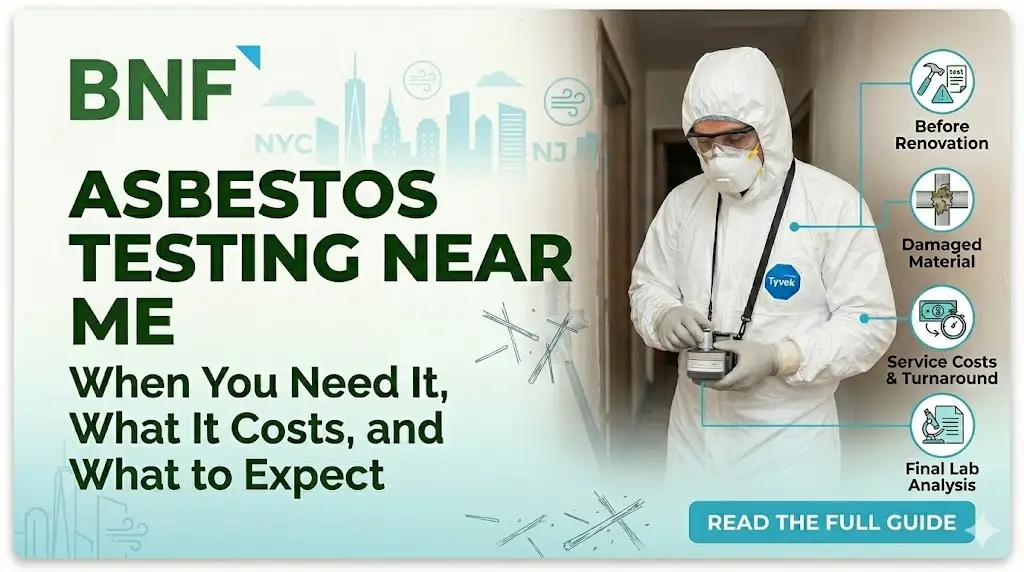
What is asbestos testing and when do you need it? Asbestos testing is a professional assessment that determines whether asbestos-containing materials are present in a building and at what concentration. In New York, New Jersey, and Connecticut, testing is legally required before any renovation, demolition, or significant disturbance of materials in buildings constructed before 1980 — and strongly recommended for any homeowner, buyer, or landlord who suspects asbestos may be present in their property. If you are searching for asbestos testing near you and are not sure whether you actually need it, what it involves, or what it costs — this guide covers all of it.
What Is Asbestos and Why Does It Require Professional Testing
Asbestos is a naturally occurring mineral fiber that was used extensively in building construction from the 1940s through the late 1970s. It was valued for its heat resistance, durability, and insulating properties — and as a result, it was incorporated into a wide range of building materials including floor tiles, ceiling tiles, pipe insulation, roofing shingles, drywall joint compound, textured paint, and HVAC ductwork insulation.
The problem is not that asbestos exists in a building. Asbestos-containing materials that are undisturbed and in good condition do not release fibers into the air. The problem arises when those materials are disturbed — through renovation, demolition, deterioration, or damage — releasing microscopic fibers that become airborne and, when inhaled, lodge permanently in lung tissue. Asbestos exposure is the sole cause of mesothelioma and a significant cause of lung cancer and asbestosis.
The only way to confirm whether a material contains asbestos is through laboratory analysis of a physical sample. Visual inspection alone — by a homeowner or even an experienced contractor — cannot determine whether asbestos is present. This is why professional testing by a certified inspector is the required and only reliable approach.
Do You Need Asbestos Testing? The Scenarios That Require It
Before any renovation or demolition work. In New York City, New York State, New Jersey, and Connecticut, asbestos surveys are legally required before renovation or demolition of buildings built before 1980. New York City's Department of Environmental Protection (DEP) requires that building owners have an asbestos survey completed by a DEP-certified inspector before any work that will disturb building materials. Contractors who begin renovation work without a survey in a pre-1980 building are in violation of local law — and building owners who authorize such work are liable.
When purchasing a home or property. Pre-purchase asbestos inspection is one of the most overlooked and most important steps in buying an older home in the tri-state area. A standard home inspection does not include asbestos testing — it is a separate assessment. Buyers who close on a pre-1980 property without asbestos testing may discover after closing that planned renovations require mandatory asbestos abatement, adding significant unplanned cost to a project.
When materials show signs of deterioration. Asbestos-containing materials that are crumbling, damaged, water-stained, or otherwise deteriorating may be releasing fibers into the air. If you have older pipe insulation that is flaking, floor tiles that are cracked, or ceiling tiles showing damage in a pre-1980 building, professional testing is the appropriate response — not DIY removal.
When you are a landlord or property manager. Building owners in New York City are subject to Local Law 55 and a range of DEP requirements related to asbestos management. Landlords undertaking any renovation work in pre-1980 rental properties are required to have an asbestos survey performed. Failure to comply exposes building owners to significant regulatory penalties.
When you simply want to know what is in your home. Many homeowners in older properties throughout Westchester County, Bergen County, Fairfield County, and the five NYC boroughs arrange asbestos testing as a baseline assessment — particularly when they have young children, immunocompromised family members, or are planning any future work on the property.
What Does Asbestos Testing Involve — The Process Step by Step
Professional asbestos testing follows a structured process. Understanding what happens at each stage removes uncertainty and helps you know exactly what you are paying for.
Step 1 — Initial consultation. A certified inspector reviews the property details, building age, and the specific concern or trigger for testing. This determines the scope of the inspection — which materials need to be sampled and how many samples are required.
Step 2 — Visual inspection. The inspector conducts a thorough visual assessment of the property, identifying materials that are suspect based on their age, appearance, and location. In a pre-1980 home, suspect materials commonly include floor tiles and backing, ceiling tiles, pipe and boiler insulation, textured ceiling coatings, roofing materials, and drywall joint compound.
Step 3 — Sample collection. Small samples of suspect materials are collected by the inspector following proper containment protocols. Sampling is performed in a way that minimizes fiber release — the area is wetted before sampling, and the sample is immediately sealed and labeled for laboratory submission. The inspector wears appropriate personal protective equipment throughout.
Step 4 — Laboratory analysis. Samples are submitted to an accredited laboratory for analysis by polarized light microscopy (PLM) — the standard method for identifying asbestos fibers in bulk materials. Results typically return within 24–72 hours depending on the laboratory's turnaround.
Step 5 — Written report. The inspector provides a written report documenting which materials were sampled, the laboratory findings for each sample, and recommendations based on the results. If asbestos-containing materials are identified, the report will specify their location, condition, and the recommended management approach — which may range from leave-in-place management to professional abatement depending on condition and planned use.
At BNF Consulting, every asbestos inspection is led by Dr. Justin Joe, CIH — a Certified Industrial Hygienist, the highest professional credential in environmental health. Because BNF Consulting does testing only — never remediation — our findings are fully independent. We have no financial interest in the abatement outcome, which means our reports carry more weight with contractors, regulators, and in any legal or dispute context.
Asbestos Testing vs. Asbestos Inspection — What's the Difference
Feature | Asbestos Testing | Asbestos Inspection |
What it involves | Laboratory analysis of collected samples | Visual survey + sampling + lab analysis |
Output | Lab results showing presence/absence | Full written report with locations and recommendations |
When used | Confirming a specific suspect material | Pre-renovation survey, pre-purchase assessment, full property assessment |
Legal compliance | Sample results alone may not satisfy DEP requirements | Full inspection report satisfies regulatory requirements |
Who performs it | Certified inspector | Certified inspector |
BNF approach | Always includes both | Always includes both |
In practice, the terms are often used interchangeably by homeowners — and at BNF Consulting, every engagement includes both the physical inspection and laboratory analysis with a written report. A lab result without a site inspection and written report does not satisfy NYC DEP or NJ DEP regulatory requirements for pre-renovation compliance.
How Much Does Asbestos Testing Cost in NYC, NJ & CT
Asbestos testing costs vary based on property size, the number of materials sampled, and the scope of the assessment. Here is a realistic framework for what to expect in the tri-state area.
Residential asbestos testing for a typical single-family home or apartment generally involves sampling of the most common suspect materials — floor tiles, pipe insulation, ceiling material, and any visibly deteriorating materials. Cost varies by number of samples collected and laboratory fees.
Pre-renovation surveys are scoped specifically to the materials that will be disturbed by the planned work. A kitchen renovation requires sampling of floor tiles, drywall compound, and any tile adhesive in the work area. A full gut renovation requires a broader survey.
Pre-purchase inspections are typically scoped to cover all commonly present suspect materials throughout the property, providing a complete baseline before the buyer closes.
BNF Consulting provides free consultations to assess what scope of inspection is appropriate for your specific situation before you commit to any service. Call (914) 297-8335 to discuss your property and get a clear picture of what testing involves and what it will cost — with no obligation.
Where Asbestos Is Most Commonly Found in NYC, NJ & CT Homes
Knowing where asbestos is most likely to be present helps set expectations before an inspection and helps homeowners understand which materials are highest priority.
Floor tiles and mastic adhesive. 9x9 inch vinyl floor tiles manufactured before 1980 have an extremely high likelihood of containing asbestos. The black mastic adhesive beneath these tiles often contains asbestos even when the tiles themselves do not. These are among the most common findings in pre-war NYC apartments and older New Jersey and Connecticut homes.
Pipe and boiler insulation. Wrapped pipe insulation in basements, mechanical rooms, and utility spaces was commonly manufactured with asbestos through the 1970s. Deteriorating pipe insulation that is flaking, crumbling, or damaged represents the highest-risk scenario for active fiber release.
Ceiling tiles and textured coatings. Drop ceiling tiles in older buildings and textured ceiling coatings — including popcorn ceilings — applied before 1980 frequently contain asbestos. These materials are particularly relevant when renovation involves removing or sanding ceiling surfaces.
Drywall joint compound. Joint compound used in construction and repair work through the late 1970s commonly contained asbestos. Sanding drywall in a pre-1980 building without prior testing is one of the most significant asbestos exposure risks for DIY renovators.
HVAC ductwork insulation. Insulation wrapped around ductwork in older HVAC systems, as well as insulation inside air handlers, was frequently manufactured with asbestos. This is particularly relevant when HVAC work or duct cleaning is planned.
Roofing and siding materials. Older asphalt roofing shingles, cement board siding, and roofing felt frequently contain asbestos. These materials are most relevant when exterior renovation or re-roofing work is planned.
Asbestos Risk by Location — NYC, NJ & CT Context
The tri-state area has one of the highest concentrations of pre-1980 housing stock in the United States, which makes asbestos testing more relevant here than in most other regions of the country.
New York City — Brooklyn, Queens, Manhattan, the Bronx, and Staten Island contain vast quantities of pre-war and mid-century residential and commercial construction. NYC has its own asbestos regulatory framework administered by the DEP, which is more stringent than state requirements in several respects. Building owners in NYC must use DEP-certified inspectors for pre-demolition and pre-renovation surveys. BNF Consulting's inspectors are DEP-certified and operate throughout all five boroughs.
Long Island — Nassau County and Suffolk County have significant concentrations of mid-century single-family housing built during the postwar suburban expansion of the 1950s and 1960s. These properties frequently contain asbestos floor tiles, pipe insulation, and exterior materials.
Westchester and the Hudson Valley — Westchester County, Putnam County, Rockland County, Orange County, Dutchess County, Ulster County, Sullivan County, Greene County, and Columbia County contain large numbers of older single-family homes and estates where asbestos is a consistent finding. Renovation projects in this region — particularly kitchen and bathroom renovations in pre-1980 homes — regularly encounter asbestos-containing materials.
New Jersey — Bergen County, Essex County, Passaic County, Union County, Hudson County, and Morris County all have substantial pre-1980 housing stock. New Jersey DEP requires asbestos surveys prior to renovation or demolition of pre-1980 structures, consistent with federal NESHAP requirements.
Connecticut — Fairfield County, New Haven County, and Litchfield County contain significant concentrations of colonial and Victorian-era housing where asbestos-containing materials are a standard finding. Connecticut DEEP regulates asbestos abatement and requires notification and survey prior to renovation or demolition of structures where asbestos may be present.
What Happens If Asbestos Is Found
Finding asbestos in a property does not automatically mean the material must be removed. The appropriate response depends on two factors: the condition of the material and whether it will be disturbed.
Asbestos-containing materials in good condition that will not be disturbed are typically managed in place. The inspector will document their location and condition, and the recommendation will be periodic monitoring rather than immediate abatement. Many properties throughout the tri-state area contain asbestos materials that have been safely managed in place for decades.
Asbestos-containing materials that are deteriorating, damaged, or will be disturbed by renovation require professional abatement before any work proceeds. Abatement involves the removal of asbestos-containing materials by licensed contractors following strict containment and disposal protocols.
BNF Consulting does testing only — never remediation. This is an important distinction. When BNF Consulting identifies asbestos-containing materials, we have no financial relationship with any abatement contractor. Our report is fully independent, and our recommendations are based solely on what the findings show — not on what generates additional revenue for us. This makes BNF's reports more credible when presented to abatement contractors for competitive bidding, to regulators, or in any dispute or legal context.
When to Arrange Asbestos Testing
Arrange a professional asbestos inspection when:
You are planning any renovation work in a building constructed before 1980
You are purchasing a pre-1980 home or property and want a complete picture before closing
You have visible pipe insulation, ceiling tiles, or floor tiles showing deterioration or damage
Your contractor has identified materials they suspect may contain asbestos before beginning work
You are a landlord planning renovation work in pre-1980 rental units
You want a baseline environmental assessment of your home for peace of mind
You need documentation for regulatory compliance, insurance, or a legal matter
Call (914) 297-8335 for a free consultation. BNF Consulting provides certified asbestos inspection and testing throughout New York City, Westchester County, the Hudson Valley, New Jersey, and Connecticut. Every inspection is led by Dr. Justin Joe, CIH. Testing only — never remediation.
Frequently Asked Questions
Q: How much is asbestos testing in NYC? Asbestos testing costs in NYC vary depending on property size, the number of materials sampled, and the scope of the assessment — whether it is a targeted inspection of specific suspect materials or a comprehensive pre-renovation survey. BNF Consulting provides free consultations to determine the appropriate scope before you commit to any service. Call (914) 297-8335 for a no-obligation assessment of your specific situation.
Q: How do you test for asbestos in NYC? Asbestos testing in NYC must be performed by a DEP-certified asbestos inspector. The process involves a visual survey of the property, collection of physical samples from suspect materials, laboratory analysis by polarized light microscopy, and a written report documenting findings and recommendations. DIY test kits are not accepted for regulatory compliance purposes and are not recommended for any situation where the results will be used to make renovation or abatement decisions.
Q: What is the 3-5-7 rule for asbestos testing? The 3-5-7 rule is a guideline used in some asbestos inspection protocols to determine the number of samples required from a homogeneous material — typically 3 samples from a small area, 5 from a medium area, and 7 from a large area of the same material type. The specific sampling protocol applied to your property depends on the type of material, its extent, and the regulatory requirements applicable to your jurisdiction. Your certified inspector will determine the appropriate sampling approach based on your specific situation.
Q: Will 30 minutes of asbestos exposure hurt you? A single brief exposure to asbestos is generally considered low risk compared to chronic long-term exposure. Asbestos-related diseases — mesothelioma, lung cancer, asbestosis — are strongly associated with repeated or sustained exposure over time, typically in occupational settings. However, there is no established safe threshold for asbestos exposure, and any exposure that involves disturbed or deteriorating asbestos-containing materials should be taken seriously. If you believe you have been exposed to disturbed asbestos materials in your home, the appropriate step is to arrange professional testing to determine whether the materials contain asbestos and whether ongoing exposure is occurring.
Q: Is asbestos testing required before renovation in NYC and NJ? Yes. In New York City, NYC DEP regulations require an asbestos survey by a DEP-certified inspector before any renovation or demolition work in buildings constructed before 1980. In New Jersey, NJDEP regulations require asbestos surveys prior to renovation or demolition of pre-1980 structures in accordance with federal NESHAP requirements. Failure to comply exposes building owners and contractors to significant regulatory penalties.
BNF Consulting provides certified asbestos inspection and testing for homeowners, buyers, landlords, and property managers throughout New York City, Westchester County, New Jersey, and Connecticut. Dr. Justin Joe, CIH, leads all inspections. BNF Consulting does testing only — never remediation. Call (914) 297-8335 or visit askbnf.com.